


If you’re managing a facility in London right now, you know the drill: high overheads and even higher safety standards. But here’s the thing—the best industrial rubber mat in London probably didn’t start its life in the UK. We’re seeing a massive shift where the most resilient, high-spec gear is coming straight out of the number one mat manufacturers in India.
It’s not just about a cheaper price tag anymore. It’s about material density that doesn’t bottom out when a forklift rolls over it.
The “Shore Hardness” Trap
Most buyers look at thickness and call it a day. That’s a mistake. You can have a two-inch mat that’s mostly air, which will tear and curl within six months of heavy traffic. Real durability is found in the best rubber mats brand in India exports, where high-pressure vulcanization is the standard. These mats are dense enough to handle point-loads from heavy machinery without developing “memory ruts.”
When you source from a rubber mat manufacturer in India with a global footprint, you’re getting a compound that has been engineered to withstand 2026’s stricter environmental codes—low-VOC, no “tire shop” smell, and zero leaching.
Sourcing Smarter in the UK
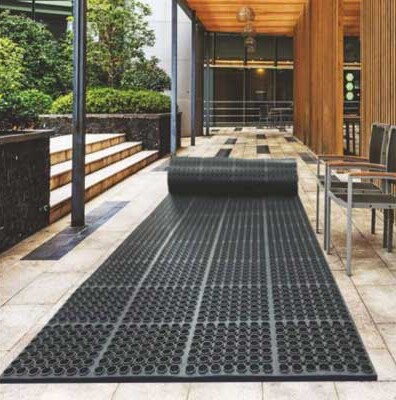
The smart move isn’t trying to bypass the local market; it’s finding the best rubber mat supplier in UK market who has the direct pipeline to these Indian powerhouses. You want the technical backup of a local partner combined with the massive manufacturing scale of a specialist like Aramats.
For high-traffic corridors or loading bays, you should be looking at:
- Nitrile-enriched blends: Essential if you’ve got oils or chemicals hitting the floor.
- Tapered-edge runners: Because a “heavy-duty” mat is just a trip hazard if it doesn’t sit flush.
- Modular interlocking systems: Stop thinking about permanent adhesives. If a section gets damaged, you swap a tile, not the whole floor.
The Bottom Line for 2026
Safety isn’t a “set it and forget it” task. As the best rubber floor mat in market evolves, so do the liabilities. A cheap mat is a liability disguised as an asset. By the time you account for the downtime and the injury risk, that “bargain” has cost you three times its value.
Go for the high-density, export-grade stuff. It’s the only way to ensure your floor stays as productive as the people walking on it.