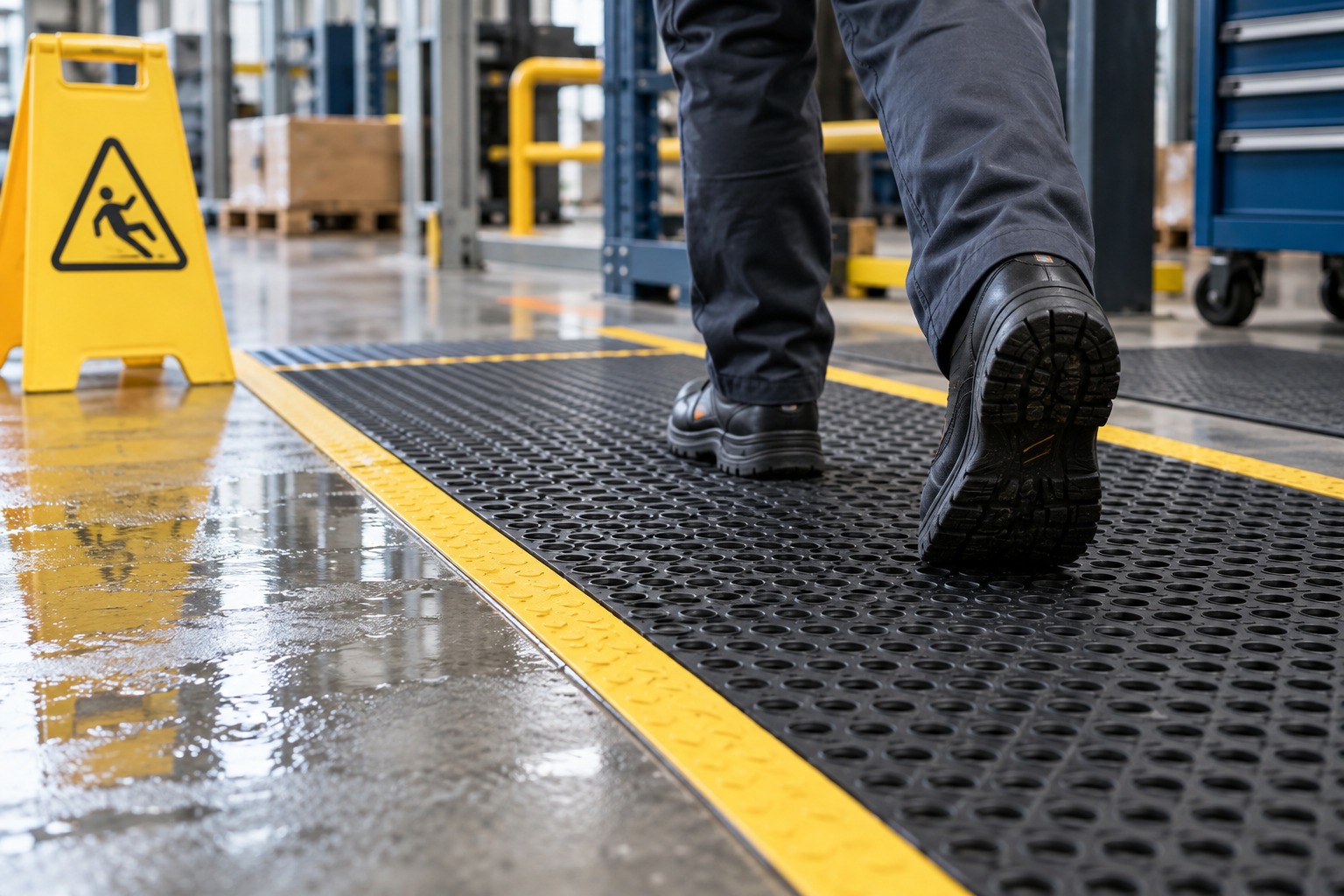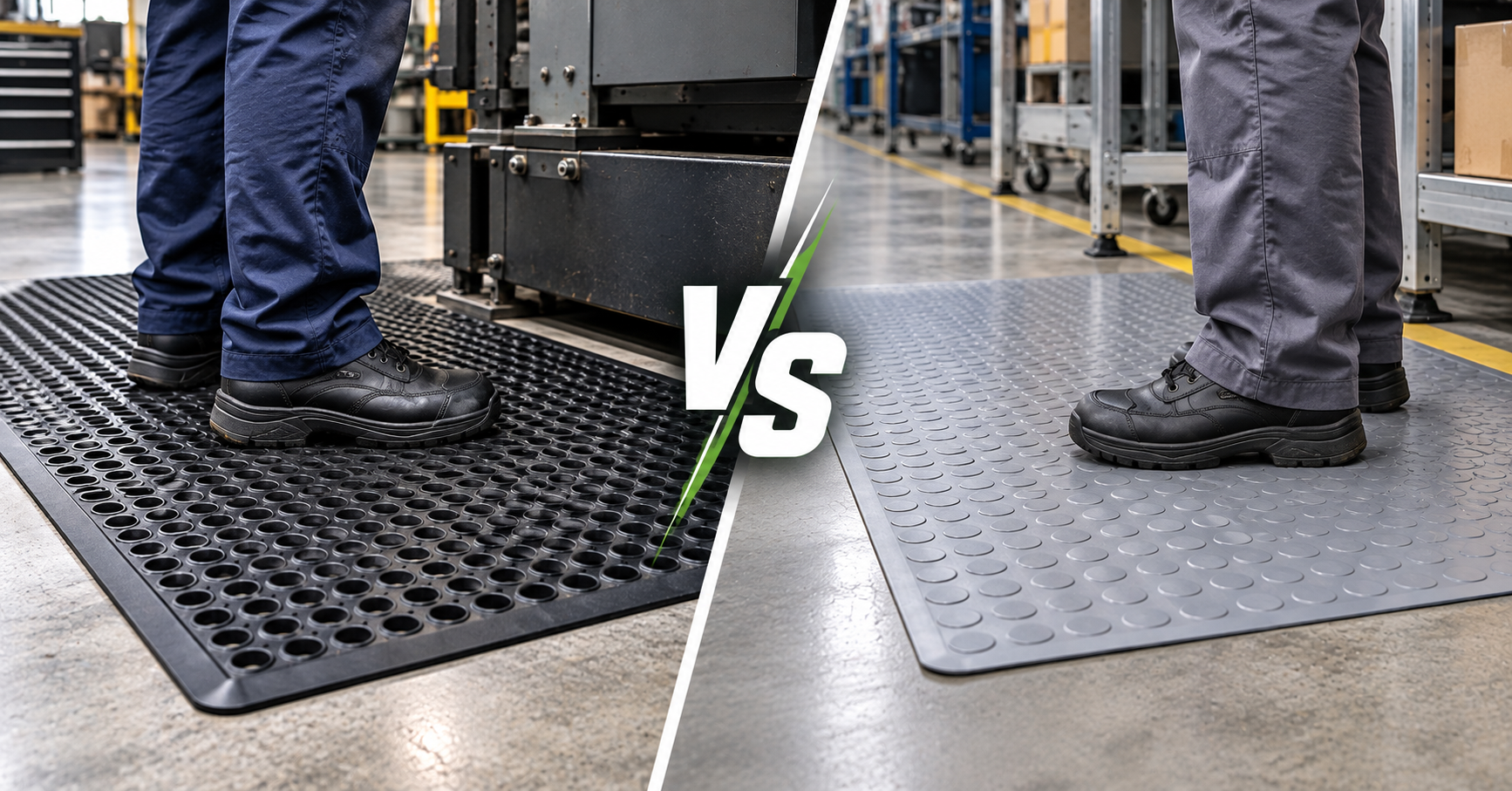
Choosing the right matting material can make a difference to workplace safety, durability, comfort, and long-term maintenance. Two commonly considered options for industrial environments are rubber and PVC mats.
But if you compare rubber mats vs PVC mats, what is better for industrial use?
The answer depends on the environment, type of work, traffic levels, exposure to moisture or chemicals, comfort needs and durability you expect. Both materials may be good for some applications, but their performance characteristics may be different.
This guide compares rubber vs PVC mats to help businesses understand which option may be more appropriate for different industrial workplaces.
Rubber Mats vs PVC Mats: What Is the Difference?
Rubber and PVC are both widely used materials for floor mats, but they offer different characteristics.
Rubber mats are known for durability, flexibility, cushioning and suitability for demanding environments. They are often considered for industrial workstations, warehouses, workshops, factories, kitchens and other high-use areas.
PVC mats are another practical solution for flooring and are available in a wide variety of designs and applications. They may be suitable where factors such as lightweight handling, special surface designs or cost are important. For a closer look at how the two materials compare more broadly, see the difference between rubber flooring and PVC flooring.
In the end, it comes down to which application is better.
Rubber vs PVC Mats: Key Factors to Consider
When comparing rubber matting vs PVC matting, businesses should look beyond the name of the material and consider how the matting will perform in the workplace it is to be used.
1. Durability
Mats are used in industrial environments where they are constantly walked on, moved around by equipment, impacted and used daily, over and over again.
Rubber is typically valued for its durability and resistance to harsh working environments, making it a preferred material for heavy-duty applications.
PVC mats can be durable as well, but the durability depends on the product construction and application for which it is intended.
In very demanding industrial environments, the choice of mat should be based on the expected load and not on material alone.
2. Comfort and Anti-Fatigue Support
Employees may spend several hours standing at industrial workstations, production lines, packing stations, and assembly areas.
Rubber’s natural flexibility and cushioning can make rubber mats a suitable option for standing-intensive environments. Businesses evaluating standing-support flooring can also review the best anti-fatigue mats for industrial workstations when comfort is a priority.
For businesses comparing industrial rubber mats vs PVC mats for employee comfort, the construction, thickness, cushioning, and intended use of the individual mat should all be considered.
3. Slip Resistance
Industrial floors can encounter water, dirt, oil, grease, and other substances.
A mat’s surface design plays an important role in providing suitable traction. Textured or patterned surfaces can be useful in applications where additional grip is required.
Rather than choosing solely between rubber and PVC, businesses should check the specific surface characteristics of the product and whether they are appropriate for the working environment.
4. Resistance to Workplace Conditions
The mats are exposed to different materials and conditions, depending on the industry and the environment.
You have oils, grease, dust and machinery in factories and workshops. In a commercial kitchen, you have water, food spills and frequent cleaning.
When considering rubber or PVC mats for industrial use, companies should make sure that the product is suitable for the materials and conditions to which it will be exposed.
5. Maintenance
Industrial mats need to be practical to clean and maintain.
Both rubber and PVC mats can be available in designs that are relatively easy to maintain, but cleaning requirements can vary depending on the product surface and workplace conditions.
Consider:
- Type of dirt or debris
- Cleaning frequency
- Spills exposure
- Cleaning techniques
- Ease of removal of the mat
Over the longer term, a mat that can be easily included in the regular cleaning routine of the workplace may be more practical.
Industrial Rubber Mats vs PVC Mats: Where Does Each Work Best?
It is contingent upon the use case.
Factories and Manufacturing Facilities
Factories are often busy places with a lot of traffic, equipment moving around, and employees on their feet for long periods of time.
Rubber mats can be a strong option for demanding workstation and production applications where durability and cushioning are important.
Warehouses
Warehouses can have high levels of movement from employees, carts, and equipment.
For workstation areas, packing zones, and other designated standing areas, either material may be considered depending on the required performance characteristics.
Workshops
Workshops may expose mats to tools, dirt, oil, grease, and repeated movement.
In comparing industrial rubber mats vs PVC mats, companies should consider the exact chemicals involved, as well as the expected amount of daily wear.
Commercial Kitchens
Commercial kitchens involve prolonged standing, moisture, spills, and frequent cleaning.
The right mat should also have the right surface performance, comfort, durability and maintenance characteristics for the kitchen environment.
Rubber Matting vs PVC Matting: Which Offers Better Long-Term Value?
Price should not be the only consideration when selecting an industrial mat.
A lower initial cost may not necessarily represent better value if the product is unsuitable for the environment and needs to be replaced frequently.
Consider the differences between rubber and PVC:
- Life design
- How often it is used
- Working conditions
- Maintenance needs
- Comfort of employees
- Replacement cost
- Performance required
For high-use industrial applications, selection of a mat based on total workplace requirements may be more advantageous than comparison based solely on purchase price.
When to Use Rubber Mats?
Rubber mats can be especially well-suited for workplaces that require:
- Excellent durability
- Everyday use
- Extended standing support
- Resilient and flexible flooring
- Applications for industrial workstations
- Industrial matting for the workplace
- Comfort and good padding
They are ideal for use in factories, workshops, warehouses, production facilities, commercial kitchens and other demanding environments.
When Should You Choose PVC Mats?
PVC mats may be worth considering when the application prioritises specific requirements such as:
- Lightweight handling
- Particular surface or design requirements
- Easy repositioning
- Specific commercial applications
- Cost considerations
However, the exact product specifications should always be checked before selecting a PVC mat for an industrial environment.
How to Choose Between Rubber Mats and PVC Mats
Before making a decision, ask:
- What will be the daily traffic for the mat?
- Will the employees be standing on it for long periods?
- Will it be in contact with water, oil, grease, or chemicals?
- Do we need padding?
- How hard does it have to be?
- How frequently will the mat be cleaned?
- What size and thickness do I need?
- Is the mat for a workstation, entrance, warehouse, kitchen, or production area?
These questions can help companies determine whether rubber or PVC is the best fit for their specific application. Businesses in the UK weighing up flooring for a wider range of spaces can also read how to choose the right rubber mat for a UK workplace.
Why Choose ARAMATS for Industrial Rubber Mats?
ARAMATS provides rubber matting solutions for industrial, commercial, workplace, and other applications.
For businesses considering rubber mats vs PVC mats, understanding the intended application is an important first step. Where the requirements call for durable rubber matting, anti-fatigue support, or heavy-duty industrial flooring, choosing an experienced rubber products manufacturer can help businesses identify a suitable solution.
ARAMATS has a wide range of rubber products for a wide range of workplace and industrial applications.
Conclusion
There is no one right answer for the rubber mats vs PVC mats debate for all industrial environments.
The right choice depends on the application’s requirements, such as traffic, durability, comfort, surface performance, exposure conditions, maintenance and long-term value.
Rubber is often a great choice for demanding industrial environments where durability, flexibility, cushioning, and the ability to stand for long periods are considerations. There may be other applications that would be applicable to PVC that require different treatment and performance.
The best approach is to select the material based on the actual needs of the workplace rather than price or material alone.
Find the Right Industrial Mat for Your Workplace
Not sure whether rubber or PVC is right for your industrial application?
ARAMATS offers a range of rubber matting solutions for commercial and industrial environments.
Explore the ARAMATS range or get in touch with the team to find the right matting solution for your workplace.
Frequently Asked Questions
Are rubber mats better than PVC mats for industrial use?
Neither material is better in general for every application. For tough industrial environments, where durability, cushioning, and long-term standing support are essential, rubber could be a better alternative, while PVC may be more appropriate for other applications.
What is the main difference between rubber and PVC mats?
Rubber matting is valued for its durability, flexibility, and cushioning, while PVC matting can provide practical solutions for a wide range of commercial and industrial applications. When comparing them, the specific product construction is important.
Are rubber mats suitable for industrial workstations?
Yes. Rubber mats are ideal for industrial workstations, particularly where employees are required to stand for long periods and a resilient, hard-wearing surface is essential.
Which is better for high-traffic industrial areas?
The proper specifications for high-traffic applications should be checked for both materials. Rubber is a common choice in demanding industrial environments because it is durable and flexible.
How do I choose between rubber and PVC mats?
When selecting a material, take into account traffic, standing time, exposure to moisture and substances, durability, comfort, maintenance, size and the specific application.

Written by the ARAMATS team at Arackathara Group, manufacturers and exporters of rubber matting solutions since 1973.