Choosing the right industrial rubber mat thickness helps improve durability, comfort and floor protection.
Choosing the right industrial rubber mat thickness is not simply about selecting the thickest mat available. In an industrial workplace, mats need to handle the conditions they are exposed to, from regular foot traffic and machinery movement to impact, point loads, moisture, and long periods of standing. For broader workplace applications, businesses can also explore industrial and commercial rubber mats.
The correct thickness can affect durability, cushioning, stability, comfort, and overall performance. But that is not the whole specification. Important are also the rubber compound, the surface design, the construction, and the intended application. For employees who stand for extended periods, anti-fatigue mats for industrial workstations may be considered alongside thickness.
So, how thick should industrial rubber mats be? The answer depends on the working environment and the demands placed on the mat.
Why Does Industrial Rubber Mat Thickness Matter?
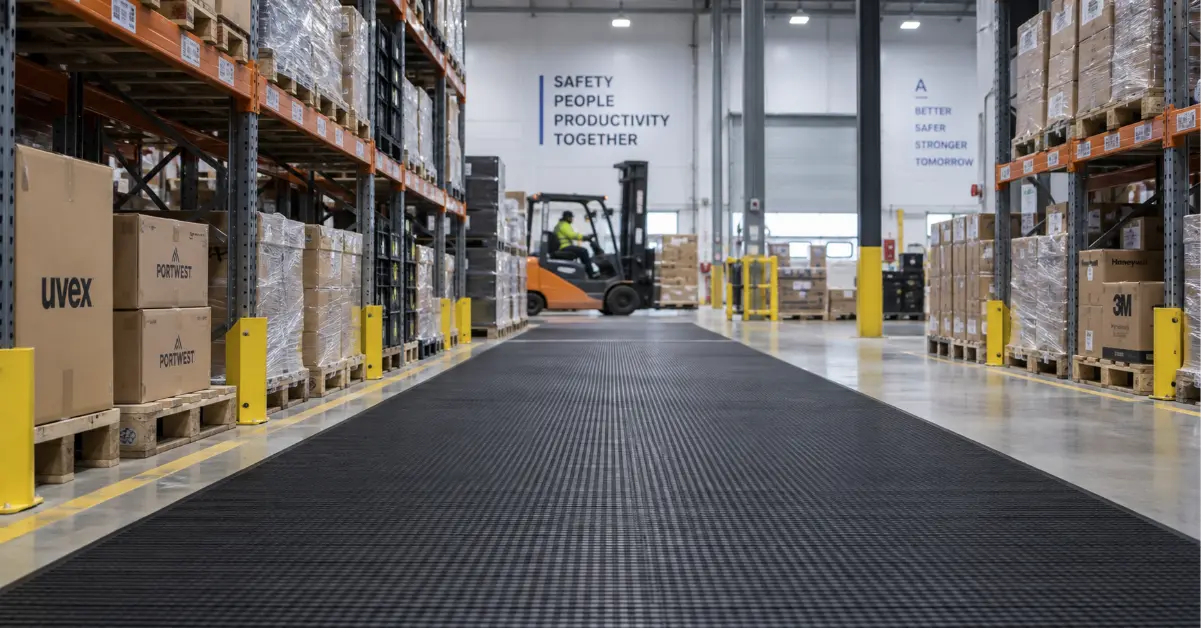
Industrial mats are used in a wide range of workplaces, including factories, warehouses, workshops, production areas, and machinery stations. These environments can place considerably more demand on flooring than a typical commercial space.
A suitable industrial mat thickness can help provide the cushioning and support required for the application. For employees who stand for long periods, the construction of the mat can also influence underfoot comfort and fatigue.
In areas exposed to equipment, impact, or frequent traffic, the mat needs to maintain its shape and performance under repeated use.
However, thickness should not be considered in isolation. A thicker mat is not automatically the most suitable option for every workplace.
How Application Affects Mat Thickness
There is no universal thickness that works for every industrial environment. The required rubber mat thickness for industrial use depends on what the mat will be exposed to and how it will be used.
For example, a workstation where employees stand for many hours has different requirements than a place where machinery produces concentrated loads. A warehouse walkway may require a different mat specification than a wet processing area, for example.
Before choosing industrial mat thickness, consider:
- Load: Will people, carts, machinery, or other equipment be using the mat?
- Point pressure: Is there pressure concentrated on certain areas from heavy equipment?
- Traffic: How often will people or equipment be walking over the mat?
- Impact: Are tools, parts, or equipment regularly falling on the surface?
- Duration of standing: Are employees standing in the same place for long periods of time?
- Workplace conditions: Is the area exposed to water, oil, dirt, heat, or other contaminants?
- Handling: Does the mat need to be lifted or moved regularly for cleaning?
This is particularly important when selecting heavy-duty rubber mat thickness. A thicker mat may offer additional cushioning and support, but thickness alone does not determine whether a product is suitable for heavy industrial use.
The mat’s rubber quality, construction, surface pattern, and intended application should all be considered together.
What Should You Look for Besides Thickness?
When choosing an industrial rubber mat, several other specifications can be just as important as thickness.
Material and Construction
Durability and performance are affected by the quality of the rubber and how the mat is made. Floors in industrial environments are subjected to constant traffic, equipment movement, and general wear and tear.
A well-constructed mat should be selected according to the conditions in which it will be used rather than thickness alone.
Surface Design
The surface pattern can affect grip, traction and the way the mat performs in the workplace.
Raised or textured surfaces can add underfoot grip and in some applications help with managing moisture or debris.
Drainage
For wet working environments, drainage can be an important consideration. Mats with suitable drainage designs can allow liquids to move away from the standing surface rather than collecting directly underfoot.
This can be particularly useful in areas where regular cleaning or water exposure is part of the working environment.
Anti-Fatigue Properties
Where employees stand for extended periods, industrial anti-fatigue mats can provide cushioning underfoot.
The purpose is not simply to make a mat thicker. Its construction and elasticity need to work together to provide appropriate support while allowing employees to stand comfortably.
Size and Coverage
The mat should also provide sufficient coverage for the area where it is needed.
A mat that is too small may leave employees standing partly on a hard floor, while poorly positioned mats can create unnecessary edges or trip points.
For larger work areas, modular or interlocking solutions can be useful where practical.
Where Are Industrial Rubber Mats Used?
The required specification can vary considerably between workplaces.
Manufacturing Areas
Production environments may involve machinery, tools, frequent movement and prolonged standing. Mats need to cope with the specific combination of traffic, impact, and workplace conditions.
Machinery Workstations
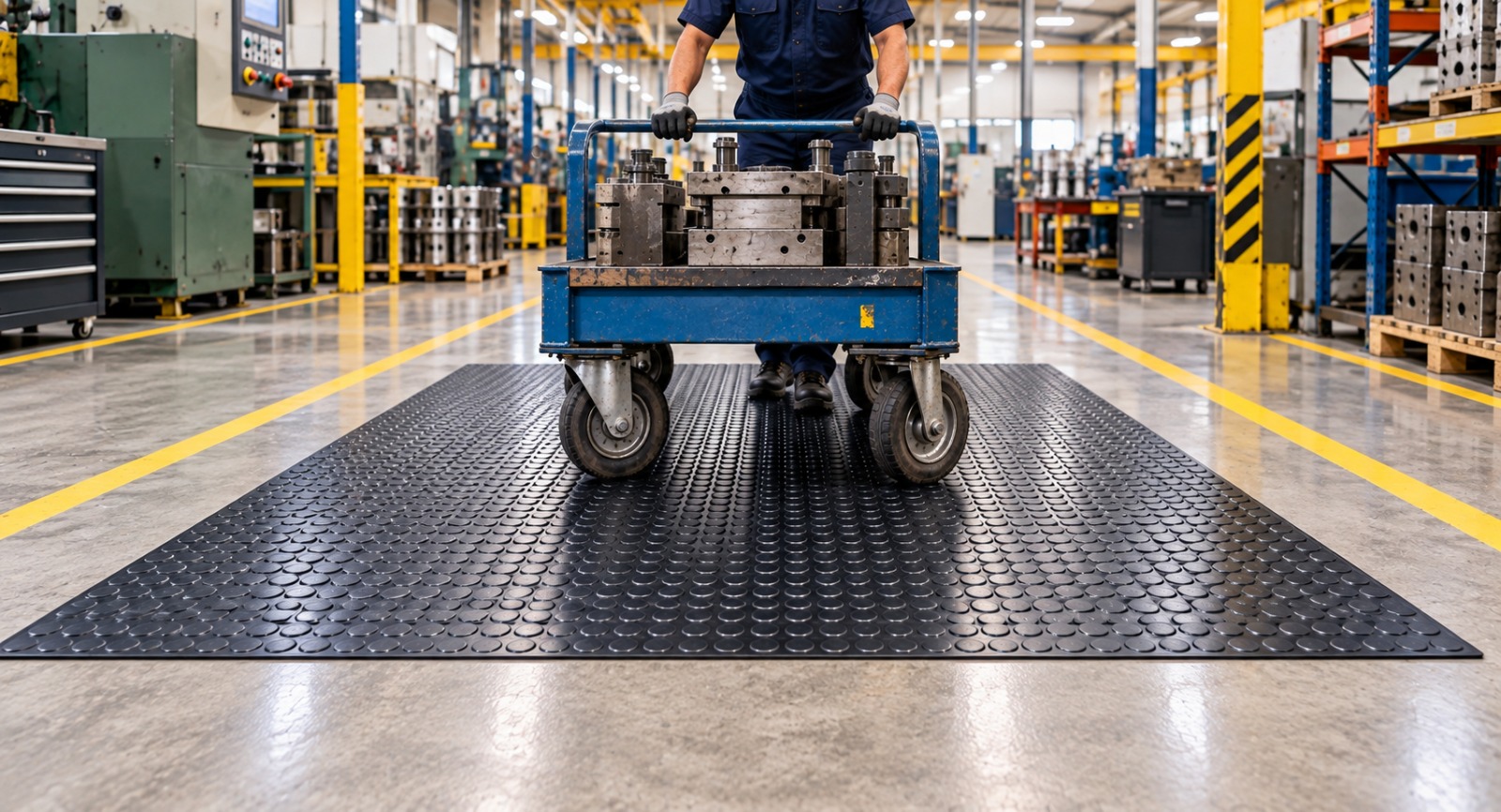
The machines may be subjected to repeated movement and concentrated loads. Here, the construction of the mat and its ability to handle point pressure must be well thought over.
Warehouses
There may be constant movement of people, carts, and equipment in warehouse environments. Durability, surface grip, and maintenance are factors that can influence the decision.
Workstations
Where employees stand at a fixed workstation, cushioning and ergonomic support may be more important than simply choosing a thicker industrial mat.
Wet or Contaminated Areas
Where water, oil, or other substances are present, surface design, drainage, and material compatibility become important parts of the selection process.
For general workplace guidance on preventing slips and trips, businesses can refer to the HSE guidance on preventing slips and trips at work.
Does a Thicker Rubber Mat Always Last Longer?
Not necessarily. Thickness can contribute to durability, but the overall construction of the mat is also important. A poorly suited mat can perform badly even if it is relatively thick.
The expected lifespan of an industrial rubber mat can be affected by:
- Frequency of use
- Type of traffic
- Equipment and load
- Exposure to oils, chemicals or other substances
- Temperature and workplace conditions
- Rubber quality
- Cleaning and maintenance
- Surface and backing design
This is why how thick industrial rubber mats should be is better treated as a specification question rather than a simple thickness question.
Proper maintenance can also support long-term performance. Businesses can review these tips for choosing the right floor matting when evaluating matting requirements.
Choosing the Right Industrial Rubber Mat
First decide what you want your mat to do.
If the main focus is on the comfort of employees on a standing workstation, then anti-fatigue properties and ergonomic design might be the way to go. If you are going to use the mat around machinery, consider the load, point pressure, and type of equipment involved.
For wet areas, drainage and surface grip may take priority. In warehouses, traffic and wear resistance can become more important.
It is also worth considering practical factors such as whether the mat needs to be moved for cleaning, whether it needs to cover a large area and whether individual sections can be replaced.
A specialist supplier can help match these requirements with the appropriate product construction and industrial rubber mat thickness.
Industrial Rubber Mats from ARAMATS
ARAMATS offers a range of rubber matting solutions designed for industrial, warehouse and workplace environments.
Its industrial range includes options such as anti-fatigue mats, drainage mats, industrial surface mats and interlocking systems, with different constructions suited to different working conditions.
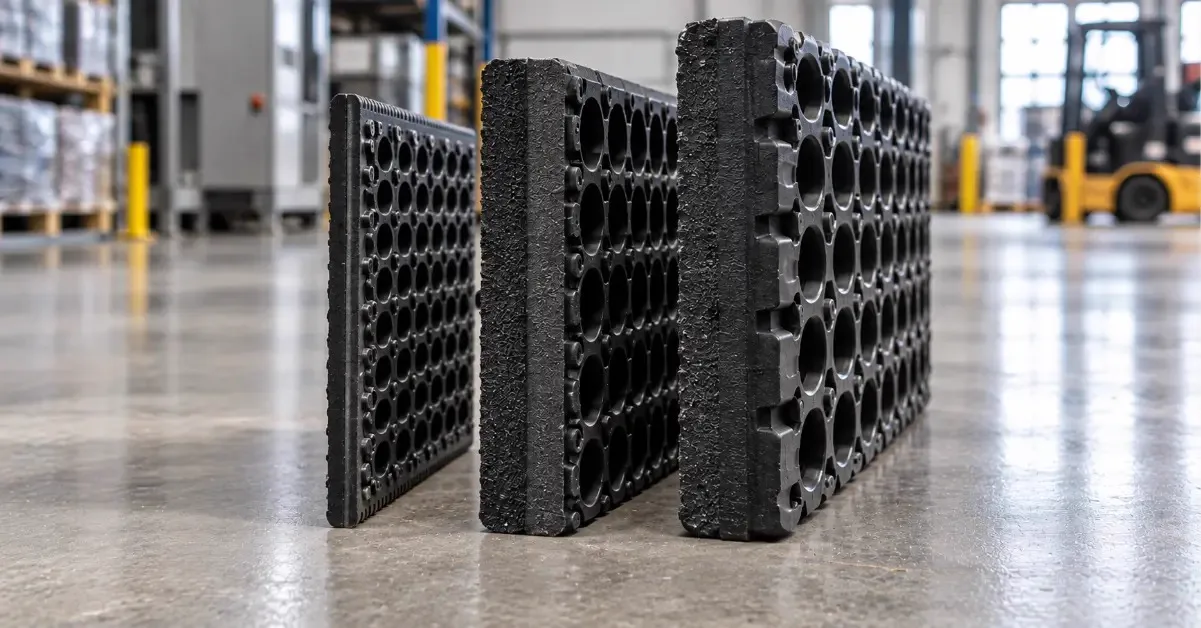
Available products include 10 mm, 12 mm, 14 mm and 15 mm options across the range. The appropriate specification should be selected according to the intended application rather than assuming that the thickest option is always the best choice.
For workplaces dealing with machinery, prolonged standing, high traffic, or demanding operating conditions, the focus should be on matching the complete mat specification to the environment.
Conclusion
The right industrial rubber mat thickness depends on the demands of the workplace. Load, traffic, point pressure, impact, standing time and environmental conditions should all be considered before selecting a mat.
A good industrial mat should do more than provide a thick layer between workers, equipment and the floor. Its material, construction, surface design, drainage and ergonomic properties all contribute to how well it performs.
The secret is to evaluate the application and then select the right product specification so businesses can invest in industrial matting that delivers the right balance of durability, safety, comfort and practical performance.
Find the Right Industrial Rubber Mat for Your Workplace
ARAMATS provides industrial rubber matting solutions for different workplace environments and applications.
Explore ARAMATS industrial rubber matting solutions to find a mat specification suited to your working conditions.
Frequently Asked Questions
How thick should industrial rubber mats be?
There is no single thickness suitable for every industrial application. The choice should take into account load, point pressure, traffic, impact, standing time, workplace conditions, and the construction of the mat.
Is a thicker industrial rubber mat better?
No, not always. Some applications call for a thicker mat for more cushioning or support, but performance isn’t all about thickness. The quality of the material, the construction, and the design of the surface must also be considered.
What is the best thickness for industrial rubber mats?
The best thickness for industrial rubber mats depends on the intended application. A workstation, machinery area, warehouse, and wet processing environment can have very different requirements.
Does heavy equipment require thicker rubber mats?
Heavy equipment can place greater loads and concentrated pressure on flooring, so the mat specification needs to account for these conditions. However, simply choosing the thickest available mat is not always the correct approach.
Are thicker rubber mats better for anti-fatigue applications?
No, not automatically. For anti-fatigue applications, the cushioning, elasticity, and overall construction of the mat are important. Thickness would be considered along with these characteristics.

Written by the ARAMATS team at Arackathara Group, manufacturers and exporters of rubber matting solutions since 1973.