Choosing the right rubber mat for an industrial workplace involves more than simply selecting the thickest option available.
Rubber mat thickness for industrial use can affect cushioning, durability, stability, handling, and the way a mat performs under repeated foot traffic or workplace loads. But thickness alone does not determine whether a mat is suitable for a particular application.
A better approach is to consider the working environment, traffic, equipment, surface conditions, and the purpose of the mat before choosing a specification.
For more guidance on selecting suitable matting for different workplace requirements, see ARAMATS' guide to choosing the right floor matting.
Why Does Industrial Rubber Mat Thickness Matter?
The right industrial rubber mat thickness can influence how a mat performs under everyday workplace conditions.
A thicker mat may provide greater cushioning or resilience in some applications, while a thinner mat may be easier to handle, install, or reposition.
However, the ideal specification depends on the mat’s construction and intended use. Surface pattern, rubber formulation, density, and overall design can all affect performance.
This is why there is no universal best thickness for industrial rubber mats.
Rubber Mat Thickness for Industrial Use: What Should You Consider?
Before choosing an industrial mat thickness, look at several factors.
1. Type of Traffic
Consider how frequently people, carts, or equipment will move across the mat.
In a busy industrial area, you may need a mat that’s designed for continuous use, but a workstation that sees little use will have different requirements.
For areas with demanding industrial traffic, you can also explore heavy-duty industrial floor mats designed for commercial and industrial environments.
2. Standing Time
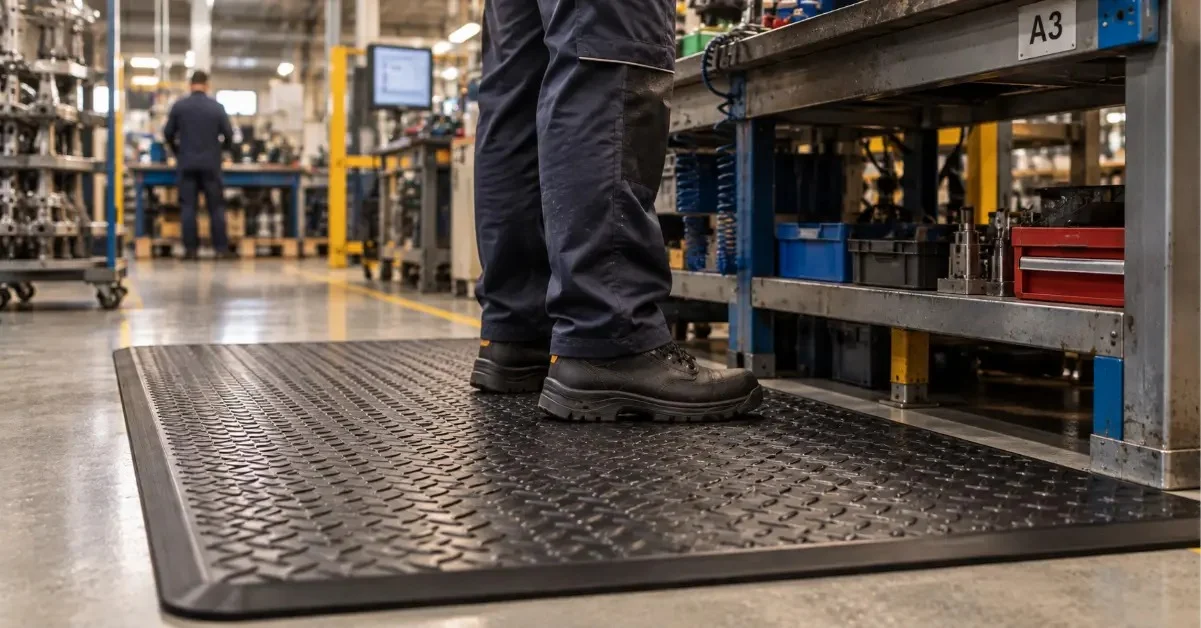
If employees stand at a workstation for long periods, cushioning and underfoot comfort become more important.
Anti-fatigue mats are designed for this type of application and are available in different thicknesses and constructions.
The objective is not simply to choose the thickest mat, but to select one that provides appropriate support while remaining stable and practical for the workstation.
3. Loads and Equipment
Industrial areas can involve machinery, tools, carts, or other equipment.
When selecting heavy-duty rubber mat thickness, consider the type and concentration of the load. Point loads can place very different demands on a mat compared with ordinary pedestrian traffic.
A thick mat, for example, for standing workers, should not automatically be considered suitable for heavy machinery.
4. Impact and Workplace Conditions
Some industrial areas experience dropped tools, repeated movement, or other mechanical stresses.
In these environments, the mat’s overall construction can be as important as its thickness.
Look at the product’s intended application and performance specifications rather than using thickness as the only selection criterion.
How Thick Should Industrial Rubber Mats Be?
So, how thick should industrial rubber mats be?
There is no single answer. Industrial rubber mats are available in a range of thicknesses because different workplaces require different levels of cushioning, support, drainage, grip, and durability.
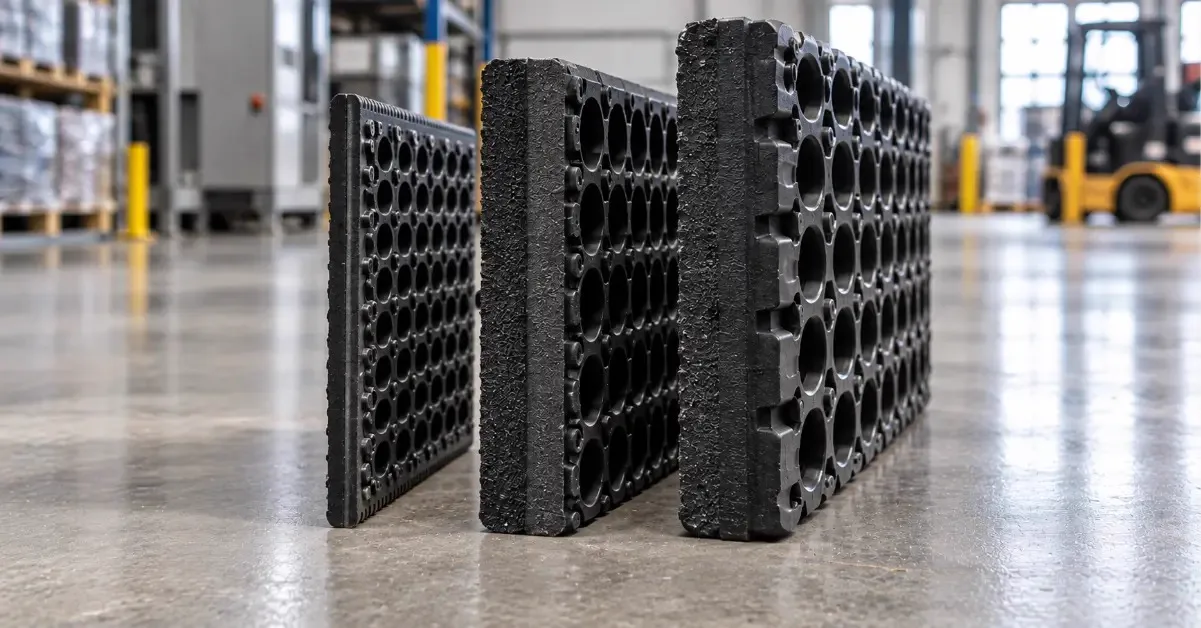
For example, ARAMATS now has industrial and warehouse mats in different specifications like 10mm, 12mm, 14mm, and 15mm in different models. These differences are a reflection of the fact that mat design varies according to intended application.
Some other rubber runner products are available in considerably thinner or thicker constructions. ARAMATS, for example, lists runner products ranging from 4 mm to 21 mm, demonstrating why thickness should always be considered alongside product design and use.
Rubber Mat Thickness Guide by Application
Rather than assigning one thickness to every application, use the following as a practical rubber mat thickness guide:
- Standing workstations: Focus on anti-fatigue performance, cushioning, stability, and the amount of time workers spend standing.
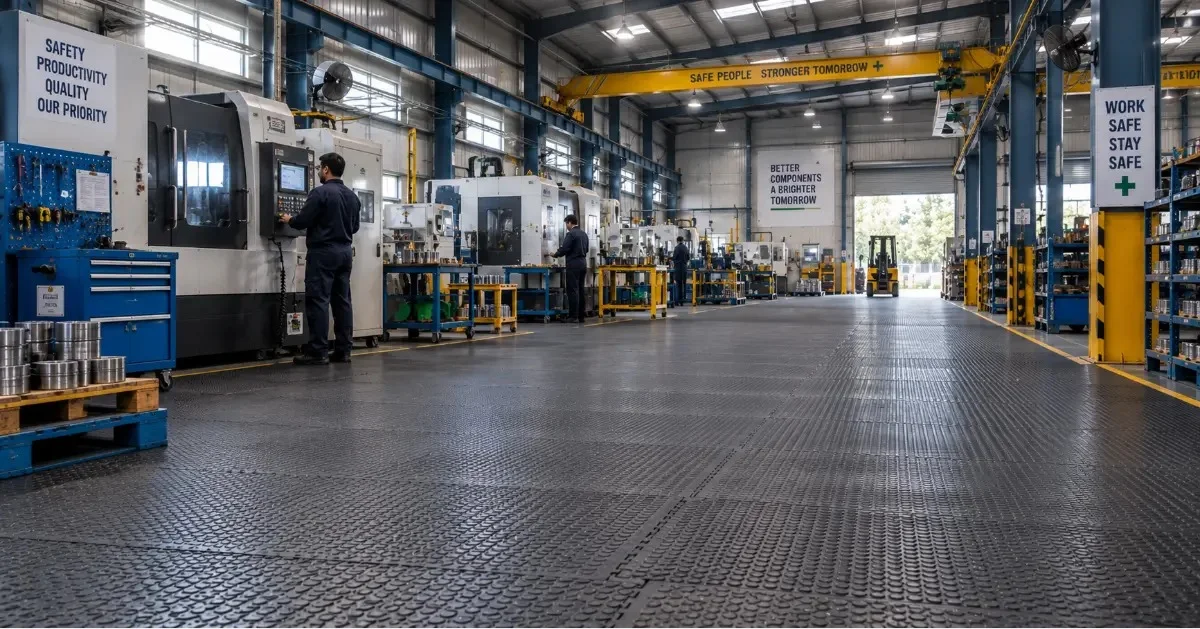
- General industrial walkways: Consider the traffic levels, grip, surface pattern, durability, and ease of movement across the mat.
- Warehouse Space: Look at pedestrian traffic, equipment movement, surface conditions, and whether the mat needs to take heavier loads.
- Areas exposed to spills or debris: Depending on the environment, open or patterned surfaces may be useful for drainage and debris management.
- Work areas for heavy-duty jobs: Don’t make your specification based on thickness alone. Consider the load, the impact, and the equipment.
This approach is more reliable than treating thickness as a fixed requirement for each workplace.
Is a Thicker Rubber Mat Always Better?
No. Choosing very thick rubber mats simply because they appear more durable can create practical problems.
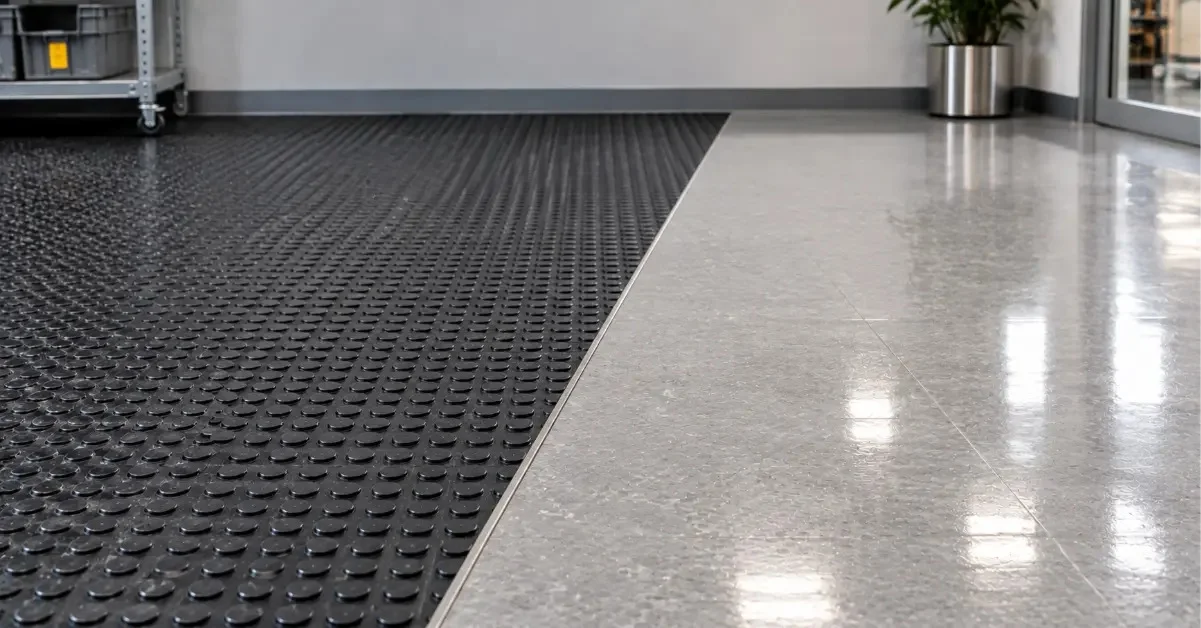
A thicker mat may be heavier and more difficult to move or clean. It can also create a transition or trip concern where it meets another floor surface if the installation is not properly planned.
On the other hand, a mat that is too thin for its intended application may not provide sufficient cushioning or durability.
The goal is to find the appropriate balance between thickness, construction, and workplace requirements.
For additional information on how rubber and PVC matting compare for industrial environments, see rubber mats vs. PVC mats for industrial use.
Thick Rubber Mats for Industrial Use
Thick rubber mats for industrial use can be useful in demanding environments where additional cushioning, resilience, or protection is required.
However, “thick” should always be understood in relation to the specific product. A 15 mm industrial mat with one-surface construction may perform differently from a 15 mm mat made for another application.
Likewise, a 10 mm anti-fatigue mat may be designed specifically for standing comfort and therefore should not be judged solely against a thicker general-purpose mat.
Product design matters.
Industrial Floor Mat Thickness and Safety
Industrial floor mat thickness should also be considered alongside workplace safety.
A mat should sit securely on the floor and should not curl, shift, or create an unnecessary change in floor level.
Your environment matters as well. For example, areas exposed to water, oils, dust, or debris may require a surface designed for that condition.
Check before installation:
- Whether the mat slides while being used
- Whether edges are a trip concern
- Whether the surface provides the right grip
- The level of cleanliness that can be achieved
- Whether the mat is appropriate for the conditions in the workplace
- Whether its size is suitable to the area it is to occupy
Thickness is one part of the specification, not a complete safety assessment.
For broader workplace slip and trip considerations, refer to the Health and Safety Executive's guidance on preventing slips and trips at work.
How to Choose the Right Industrial Rubber Mat
When comparing industrial mats, consider the following questions:
- What is the mat being used for? Define whether the priority is anti-fatigue comfort, floor protection, grip, drainage, insulation, or general industrial use.
- Who and what will move over it? Consider workers, carts, machinery, and other equipment.
- How frequently will it be used? Continuous industrial traffic can place different demands on a mat than occasional use.
- What conditions will it face? Moisture, dirt, oils, temperature, and other workplace conditions may influence the appropriate product.
- Does the mat need to be moved regularly? If workers need to reposition or clean the mat frequently, handling and weight become practical considerations.
ARAMATS Industrial Matting Options
ARAMATS offers a range of industrial and warehouse rubber mats in different constructions and dimensions.
Its current industrial range includes products such as Bubble Mats, Finger-Tip Anti-Fatigue Mats, Pyramid Pin Mats and Comfort Lock Mats, with specifications including 10 mm, 12 mm, 14 mm and 15 mm thicknesses.
The appropriate option depends on the working environment and the purpose of the mat rather than thickness alone.
For standing workstations, you can also explore anti-fatigue mats for industrial workstations.
Conclusion
In terms of choosing the right industrial rubber mat thickness, there’s no need to automatically think thicker is better. It’s all about matching the product to the workplace.
Factors to consider are mat thickness, traffic, standing time, equipment, loads, surface conditions, cleaning, and safety. This ensures that the product selected is practical for the environment and will serve its purpose.
Find the Right Industrial Rubber Mat
ARAMATS offers industrial and warehouse rubber mats in a range of constructions and thicknesses for different workplace requirements.
Explore ARAMATS industrial rubber matting options to find a specification suited to your application.
Frequently Asked Questions
What thickness of rubber mat is best for industrial use?
There is no single best thickness for industrial rubber mats. The appropriate thickness depends on the application, traffic, loads, standing time, surface conditions, and the construction of the mat.
What is the recommended rubber mat thickness for industrial use?
The appropriate rubber mat thickness for industrial use varies by application. Industrial mats are available in different thicknesses because workstations, walkways, warehouses, and heavy-duty areas have different requirements.
Is a thicker rubber mat more durable?
Not necessarily. Thickness may provide performance advantages, but rubber formulation, density, construction, surface design, and the way the mat is used also affect durability.
How thick should industrial rubber mats be for standing workers?
For standing workers, look at the anti-fatigue properties of the mat, including the cushioning and stability, not just the thickness. The proper specification is a function of the workstation and conditions of work.
Are 10 mm rubber mats suitable for industrial use?
Some 10 mm mats are specifically designed for industrial or anti-fatigue applications. ARAMATS, for example, lists 10 mm Finger-Tip Anti-Fatigue and Pyramid Pin mats. Suitability depends on the intended application.
Do heavy-duty applications require thicker mats?
Not automatically. Heavy-duty rubber mat thickness should be selected according to the type of load, impact, traffic, and equipment involved, together with the mat’s construction and performance specifications.

Written by the ARAMATS team at Arackathara Group, manufacturers and exporters of rubber matting solutions since 1973.