
Aramats Team
Written by the Aramats team at Arackathara Group, manufacturers and exporters of rubber matting solutions since 1973.
Written by the Aramats team at Arackathara Group, manufacturers and exporters of rubber matting solutions since 1973.
If you manage an industrial or commercial facility in London, you understand the challenges of rising operational costs and increasingly important workplace safety requirements. Choosing the right flooring is an essential part of maintaining a productive and well-managed working environment.
Interestingly, the best industrial rubber mat in London does not necessarily come from a UK-based manufacturer. Businesses are increasingly exploring international suppliers, including established Indian manufacturers, to compare product quality, manufacturing capacity and bulk-order options.
For procurement teams, the decision is no longer just about finding a cheaper product. It is about selecting rubber flooring with suitable material density, durability and performance for demanding workplace conditions.
Explore industrial and commercial rubber mats from Aramats to learn more about flooring options for different industrial applications.
Many buyers focus primarily on mat thickness when comparing industrial flooring products. However, thickness alone does not determine durability.
A thick mat with unsuitable material composition or low density may deform under repeated pressure and heavy traffic. For industrial environments, buyers should also evaluate rubber density, hardness, tensile strength, surface design and resistance to wear.
Businesses looking for the best rubber mats brand in India should request detailed product specifications before placing an order.
Important considerations include:
When sourcing from a reliable rubber mat manufacturer in India, ask for product-specific test reports and technical documentation rather than relying only on general claims about quality.
For a better understanding of rubber materials, read EPDM vs SBR vs Nitrile Rubber Mats: Which One Is Best?.
The smart procurement approach is not necessarily to bypass the local UK market. Instead, businesses can compare local suppliers with international manufacturers and evaluate which option best meets their technical and commercial requirements.
Finding the best rubber mat supplier in the UK market involves looking at product availability, delivery arrangements, technical support and after-sales service.
For businesses considering direct imports, Indian manufacturers may offer additional options in terms of manufacturing capacity, product variations and bulk-order supply.
Before choosing a supplier, compare:
A supplier with clear technical information and dependable delivery arrangements can make procurement more straightforward.
For high-traffic corridors, manufacturing floors and loading bays, selecting the correct mat specification is important.
Nitrile rubber, also known as NBR, is commonly considered for applications where resistance to oils is important.
Businesses working with lubricants, oils or selected industrial chemicals should verify the chemical compatibility of the specific rubber compound before purchasing.
Explore nitrile rubber and its applications in rubber mat manufacturing.
Industrial mats placed in walkways and workstations should be positioned securely. Raised or poorly fitted edges can create trip hazards.
Tapered-edge designs may help create a smoother transition between the mat and the surrounding floor. Buyers should check the edge design, dimensions and installation requirements.
Read the essential guide to rubber floor runners for more information about their uses.
Large industrial spaces may require flooring that can be installed in sections.
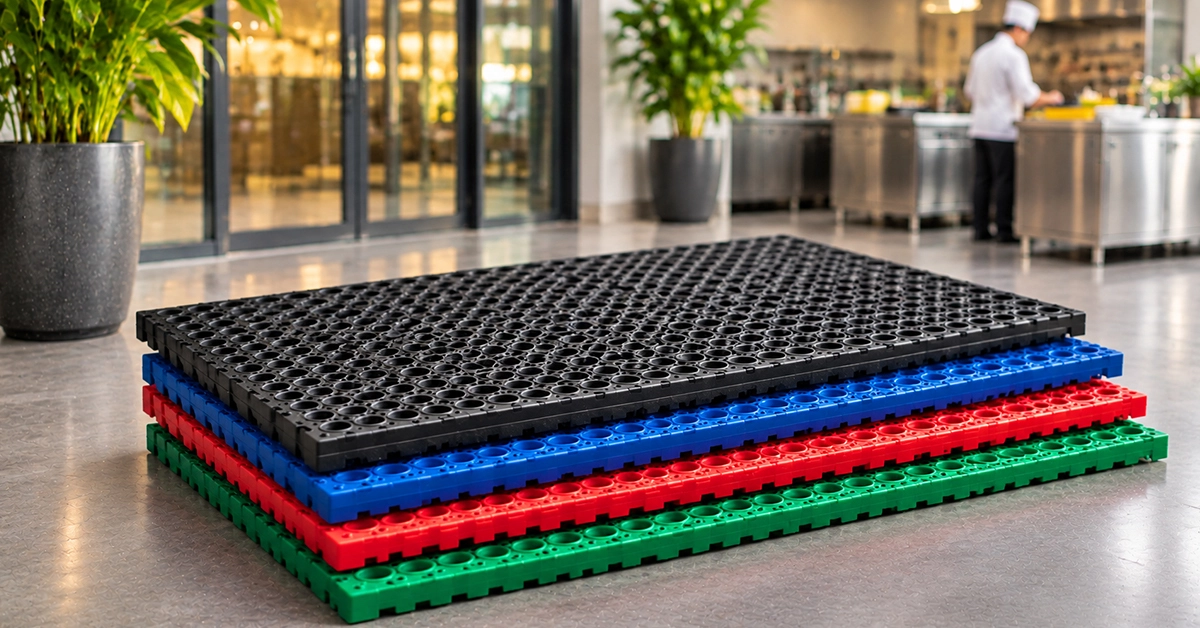
Modular interlocking rubber mats use connecting edges to join individual pieces. Depending on the design, this can make it easier to replace a damaged section without removing the entire flooring area.
Explore modular rubber mat systems to understand their applications in commercial and industrial spaces.
Industrial flooring should be selected according to the conditions of the workplace. Moisture, oil, dust, footwear and cleaning procedures can all affect slip risk.
Businesses should review the relevant risk assessment and choose products supported by appropriate test information. A textured surface alone does not guarantee slip resistance.
For workplace safety guidance, consult the UK Health and Safety Executive's guidance on slips and trips.
Buyers should also request relevant product documentation where fire performance, electrical insulation or chemical resistance is important. These properties should never be assumed without suitable evidence.
Industrial flooring is a long-term operational decision, not simply a one-time purchase. A low-cost mat may not provide the durability or suitability required for a demanding workplace.
When evaluating the best rubber floor mat in the market, consider the total cost of ownership, including product quality, installation, maintenance, replacement requirements and potential operational disruption.
For London businesses, comparing UK distributors with Indian manufacturers can help identify suitable sourcing options. The right decision should be based on verified technical specifications, reliable supply arrangements and the actual needs of the facility.
Explore Aramats industrial and commercial rubber flooring solutions to review available options for workplace applications.
Ultimately, the best industrial rubber mat is one that meets the requirements of the working environment, provides dependable performance and offers long-term value for the business.