Choosing flooring for a commercial space is about more than appearance. Businesses also need to think about foot traffic, maintenance, comfort, installation, durability, and the activities taking place on the floor.
Two options that often come into consideration are rubber and vinyl. But rubber mats vs. vinyl flooring is not necessarily a case of choosing one material for every commercial environment. Businesses can also explore different commercial floor matting solutions when specific areas require additional protection or comfort.
Both have different characteristics and can work well in different situations. The better choice depends on what the space needs from its flooring.
Rubber vs Vinyl Flooring: What’s the Difference?
Rubber and vinyl are both resilient flooring materials, but they are not the same. Vinyl flooring is generally made from PVC and other additives and is available in a wide range of colours, patterns, and formats. Rubber flooring is manufactured from natural and/or synthetic rubber formulations, depending on the product.
The difference becomes more relevant when looking at how each material performs in a particular commercial environment.
Rubber Flooring vs Vinyl: Key Considerations
When comparing rubber flooring vs vinyl, consider the following:
- Traffic Type and Volume
- Comfort for your feet
- Grip on Surface
- Moisture exposure
- Requirements for cleaning
- Wear resistance
- Installation steps
- Design specifications
- The need for targeted floor protection
- Whether the flooring is permanently installed or needs replacement
No single specification makes one material universally better.
Durability and Commercial Traffic
Commercial flooring can experience significant daily traffic, particularly in retail spaces, offices, public buildings, schools, healthcare environments, and service areas.
Some rubber flooring products are designed for demanding environments and can provide high wear resistance and resistance to indentation.
Vinyl also has products specifically designed for demanding commercial applications. For example, homogeneous vinyl flooring is available with constructions intended for high-traffic environments and can offer resistance to chemicals, scratches, and stains depending on the product.
This is why comparing the materials alone is not enough. Product specification matters.
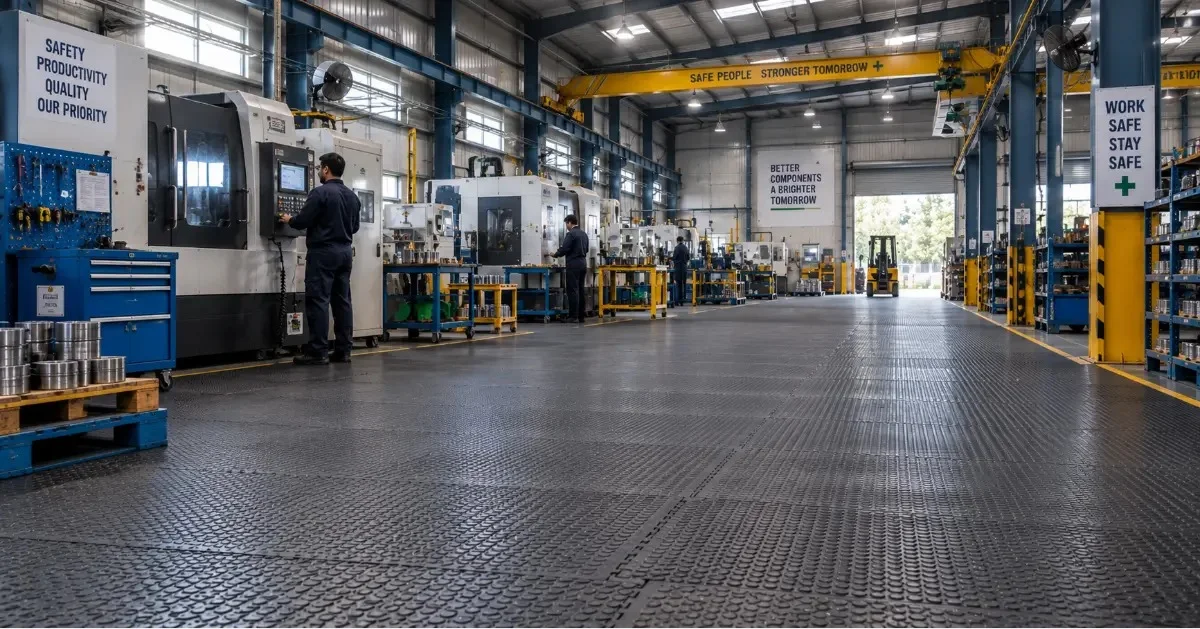
For demanding workplaces, businesses can also consider heavy-duty industrial rubber floor mats for areas where additional floor protection is required.
Comfort Underfoot
Comfort can be important in commercial spaces where employees spend long periods standing.
Rubber has elastic properties, and some rubber flooring products are designed to provide underfoot comfort and ergonomic support.
Vinyl can also provide a resilient surface, with some commercial vinyl products designed specifically around comfort and acoustic performance.
For workstations where employees stand for extended periods, rubber mats or vinyl flooring should therefore be considered based on the actual working conditions rather than material name alone.
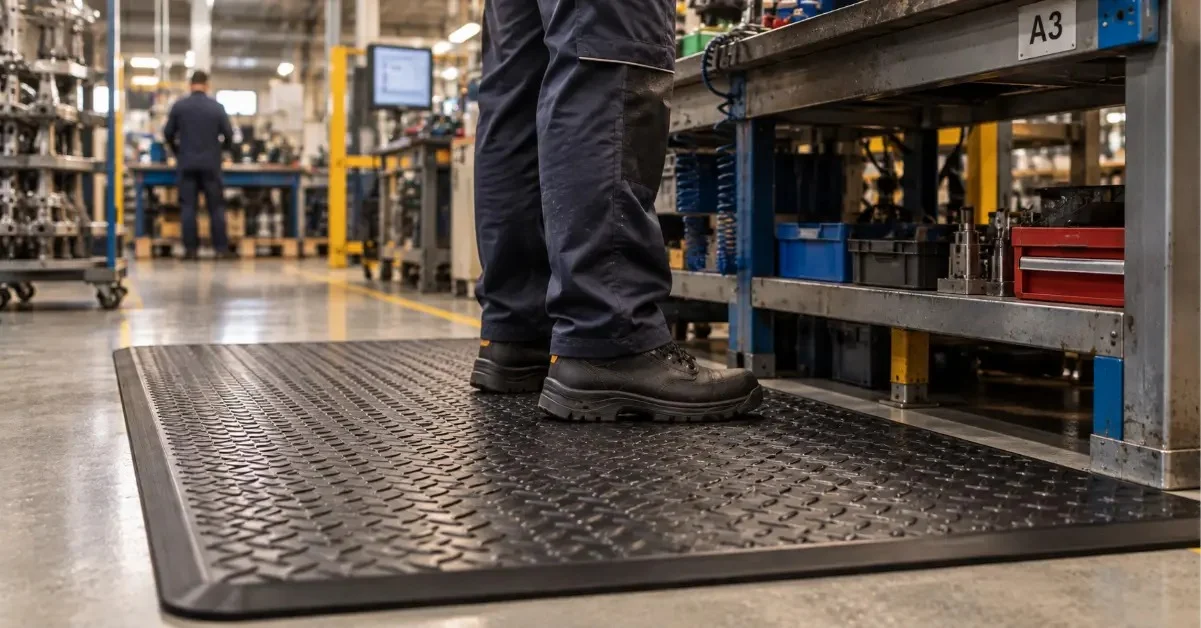
A targeted anti-fatigue rubber mat may also be more practical than changing the flooring throughout an entire commercial space. Businesses can explore anti-fatigue rubber mats for industrial workstations when employees spend extended periods standing.
Maintenance and Cleaning
Commercial floors need to fit into the cleaning routine of the building. Some rubber flooring systems have dense surfaces designed for straightforward cleaning and do not require additional coatings, depending on the product.
Vinyl products can also be designed for easy cleaning and low-maintenance commercial use. For example, certain commercial vinyl flooring products are specifically promoted for their ease of cleaning and maintenance.
The exact maintenance requirements should always be checked against the manufacturer’s recommendations.
For workplaces where spills, moisture, or frequent foot traffic are concerns, businesses should also consider surface grip and maintenance requirements when selecting rubber floor mats.
Design and Appearance
For customer-facing spaces, appearance can be just as important as performance.
Vinyl offers a particularly broad range of colours, patterns and formats. Luxury vinyl products can also reproduce wood and stone-inspired appearances, making them useful where a particular interior aesthetic is required.
Rubber flooring is also available in different colours, textures and designs, although its visual character is often more closely associated with functional commercial and institutional environments.
For a retail, hospitality or office project where the floor forms a major part of the interior design, the available product ranges should be compared rather than making a decision based only on material.
Rubber Flooring for Commercial Spaces
Rubber flooring for commercial spaces can be particularly useful where durability, resilience, underfoot comfort, and surface performance are priorities.
It can be found in environments such as:
- Offices
- Shopping areas
- Educational buildings
- Health care settings
- Public use areas
- Industrial and occupational field
Rubber flooring products are available as either sheets or tiles and have a wide range of surfaces and performance characteristics.
For businesses that do not need permanent flooring across an entire building, rubber mats can provide another option.
Commercial Vinyl Flooring
Commercial vinyl flooring is available in sheet, tile and plank formats, with products designed for different levels of traffic and specific requirements.
Depending on the product, vinyl can offer design flexibility, easy cleaning, slip-resistant surfaces and specialised performance characteristics. Some commercial vinyl ranges are specifically designed for heavy traffic and intense use.
Vinyl can therefore be particularly attractive for businesses looking for a continuous finished floor with a specific visual appearance.
Rubber Mats or Vinyl Flooring?
The choice between rubber mats or vinyl flooring often comes down to how the space is being used.
If the business needs a permanent, continuous floor covering across a large commercial interior, vinyl may be considered alongside other resilient flooring options.
If only particular areas need additional cushioning, grip, or floor protection, rubber mats can be a more targeted solution.
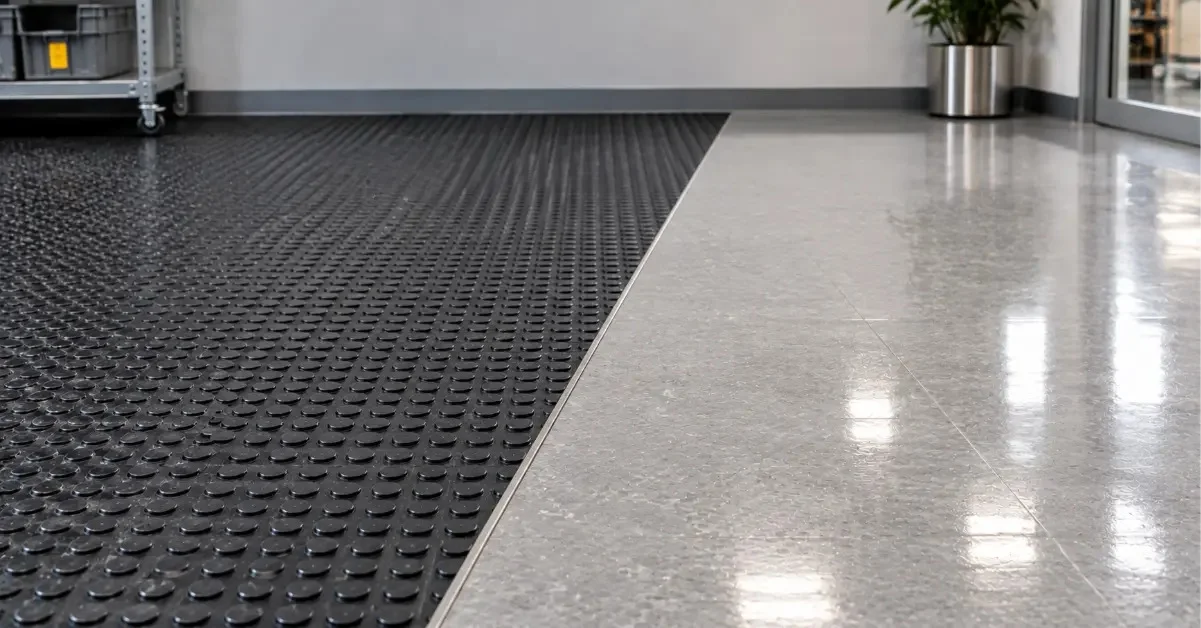
For example, a business might use vinyl as its main floor covering and place anti-fatigue rubber mats at standing workstations.
This combined approach can sometimes make more practical sense than treating rubber and vinyl as mutually exclusive options.
Commercial Rubber Flooring vs Vinyl Flooring: What About Cost?
Cost depends heavily on the specific product, installation requirements, floor preparation, area size, and expected service life.
A lower initial price does not necessarily mean lower overall cost, just as a more expensive flooring product is not automatically better for every application.
Businesses should consider the total requirements of the project, including:
- Material cost
- Installation
- Subfloor preparation
- Cleaning and maintenance
- Replacement requirements
- Downtime during installation
- Expected traffic
- Intended service conditions
Getting product-specific quotations is the most reliable way to compare actual project costs.
Choosing Flooring for Commercial Areas
When deciding on the best flooring for commercial areas, start with the environment rather than the material.
A reception area, retail shop, office, workshop, and industrial workstation have different flooring requirements.
Ask:
How much traffic will the floor receive?
High-traffic areas may require a product designed specifically for intensive use.
Will people stand for long periods?
If so, comfort and resilience should be considered.
Will the floor be exposed to moisture or spills?
Surface design, cleaning, and slip resistance may become more important. Businesses should also review established workplace guidance on preventing slips and trips, such as the Health and Safety Executive guidance on preventing slips and trips at work.
Is appearance a major consideration?
If the floor is a central part of the interior design, compare the available colours, patterns, and formats.
Does the whole floor need to be replaced?
If only certain areas need additional support or protection, commercial rubber mats may provide a more targeted solution.
Choosing Rubber Mats from ARAMATS
ARAMATS offers rubber matting solutions for commercial, workplace, and industrial applications.
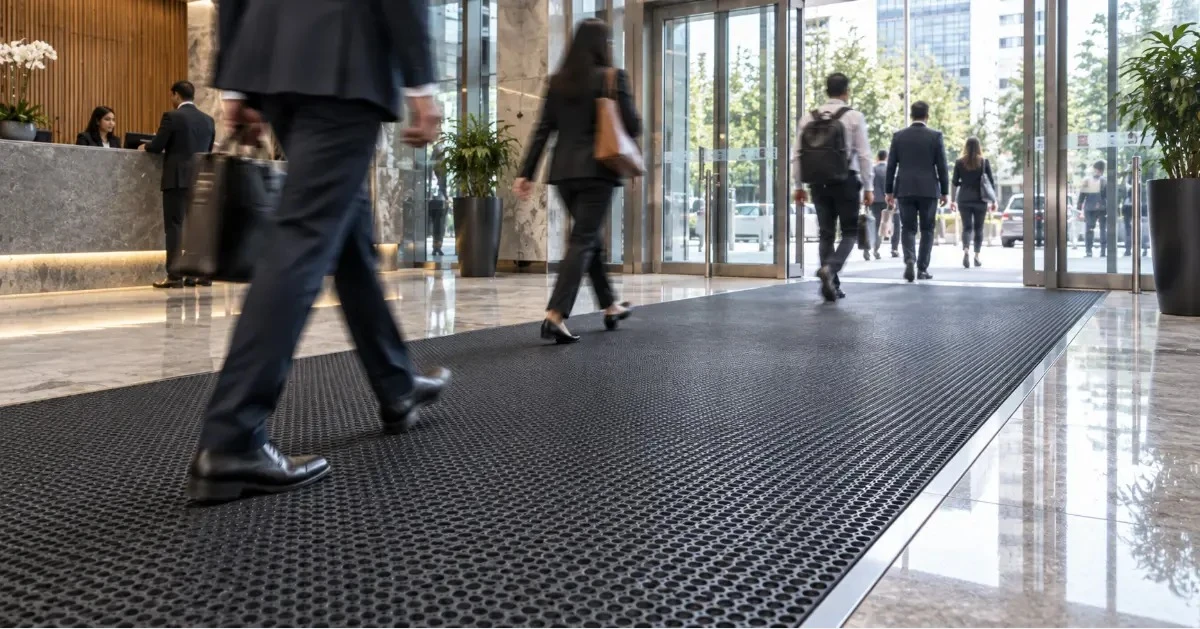
Rather than replacing an entire commercial floor, businesses can use suitable rubber mats in specific areas such as entrances, workstations, service points, or other locations where additional cushioning, traction, or floor protection is required.
This makes rubber matting a practical complement to permanent flooring as well as a standalone option for selected commercial areas.
Conclusion
The choice between rubber mats vs vinyl flooring depends on what the commercial space actually needs. Vinyl can offer extensive design options and a range of commercial flooring constructions, including products designed for heavy traffic and specialised environments. Rubber can provide durability, resilience and underfoot comfort, while rubber mats offer a practical way to target specific areas without replacing the entire floor.
Rubber and vinyl are not the only choices for many commercial spaces. Different needs in the same workplace can be met by a mix of permanent flooring and rubber matting placed strategically.
Find the Right Commercial Matting Solution
ARAMATS provides rubber matting solutions for commercial, industrial, and workplace applications.
Explore the Aramats rubber matting range to find rubber matting suited to your commercial space and its day-to-day requirements.
Frequently Asked Questions
Are rubber mats better than vinyl flooring?
Neither material is universally better. Rubber mats vs vinyl flooring should be evaluated according to traffic, comfort, maintenance, design, installation, and the specific use of the commercial space.
What is the difference between rubber flooring and vinyl flooring?
Rubber flooring is made using natural and/or synthetic rubber, while vinyl flooring is generally made from PVC and other additives. Both are resilient flooring materials but have different properties and product options.
Is rubber flooring good for commercial spaces?
Yes. Rubber flooring for commercial spaces is available in products designed for demanding environments and can offer durability, resilience, comfort, and slip resistance depending on the product.
Is commercial vinyl flooring durable?
Many commercial vinyl flooring products are specifically designed for high-traffic and demanding commercial environments. However, durability varies by product construction and specification.
Should I choose rubber mats or vinyl flooring for a workplace?
Decide if you want to have permanent flooring throughout the space, or just in certain areas. Vinyl may work well for an entire floor installation, while rubber mats can be useful in individual workstations or high-use areas.
Can rubber mats be used over vinyl flooring?
In suitable applications, rubber mats can be placed over existing flooring, but compatibility should be checked with the flooring and mat manufacturer. The mat should also sit securely without creating movement or trip hazards.

Written by the ARAMATS team at Arackathara Group, manufacturers and exporters of rubber matting solutions since 1973.