
Aramats Team
Written by the Aramats team at Arackathara Group, manufacturers and exporters of rubber matting solutions since 1973.
Many factory workers spend several hours at the same workstation. This is common in assembly lines, packaging areas, shop floors and workshops. Standing for long periods on hard concrete flooring can cause discomfort, especially when the job involves limited movement.
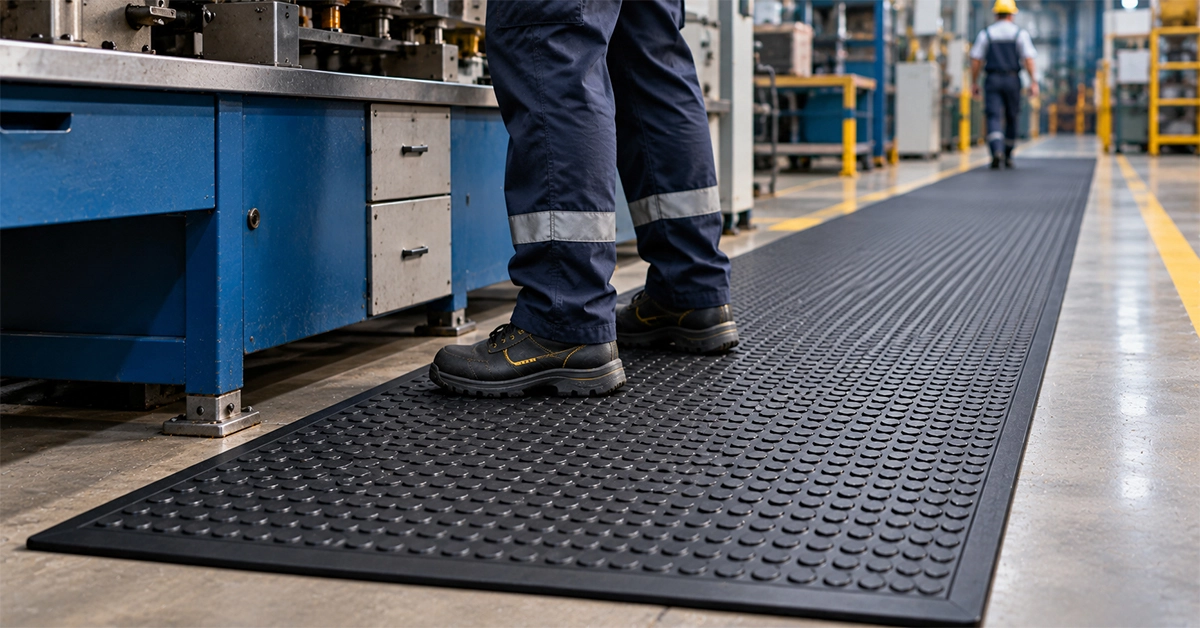
An anti-fatigue rubber runner can provide a more resilient surface for standing and walking in designated work areas. However, not all rubber mats offer the same performance. When considering anti-fatigue rubber runners in India, businesses should evaluate surface design, thickness, firmness, material quality and placement.
Explore the rubber matting solutions from Aramats to understand the different flooring options available for commercial and industrial applications.
Concrete and tiled floors are relatively easy to maintain, but they offer limited cushioning. Employees who stand for most of their shifts may experience discomfort in their feet, legs and lower back.
An anti-fatigue runner provides a more resilient surface underfoot. Its construction is intended to support standing comfort by providing some cushioning. The level of comfort depends on the material, thickness, density and firmness of the mat.
Rubber runners can also help define work areas. They are useful along production lines, next to machinery and at workstations where employees repeatedly stand in one position.
For additional information, explore the benefits of anti-fatigue mats for industrial workstations.
The location of a mat directly influences the type of runner required. A dry assembly station, for example, has different flooring requirements from a food preparation area or a workshop exposed to oil and debris.
Assembly-line workers often remain at the same workstation for extended periods. Industrial rubber runners can be installed along these working areas to provide a cushioned standing surface.
The runner should be wide enough to cover the employee's usual standing position without obstructing movement or access to equipment.
Packaging, sorting and quality-checking activities often require employees to stand in one place and handle products repeatedly. Anti-fatigue floor runners can help make these workstations more comfortable.
In these areas, a mat with an easy-to-clean surface may be practical, particularly where packaging materials or small particles accumulate on the floor.
Workshops may experience heavier foot traffic, with tools and equipment moving across the floor. Heavy-duty rubber runners are worth considering where the mat needs to withstand regular use.
Choose a product according to the workshop environment. If the floor is exposed to oil, chemicals or sharp debris, check the manufacturer's material specifications before installation.
Businesses can also explore industrial and commercial rubber mats for different workplace flooring requirements.
Commercial kitchen workers spend long periods standing while preparing food, washing utensils and handling supplies. Kitchen rubber floor runners can provide cushioning in selected work areas.
Kitchen mats must also be appropriate for the conditions in which they are used. Grip and material performance can be affected by water, grease and cleaning chemicals. A rubber runner is not automatically slip-proof.
Read more about rubber matting for commercial kitchens when comparing flooring options for food preparation environments.
Rubber floor runners are used in some workplaces for narrow aisles, areas along counters and frequently used walkways. They can help protect selected floor areas and provide a defined walking surface.
Runners used in these locations should remain flat and stable underfoot. Raised edges or movement during use can create tripping hazards.
How a mat responds to body weight is an important factor in its anti-fatigue performance. A suitable surface should provide some cushioning while remaining firm enough to support stable standing.
A mat that is too hard may provide limited cushioning. If it is too soft, employees may feel unstable while standing. The right balance depends on the workers, workstation and intended application.
It is also important to understand the difference between anti-slip and anti-fatigue features.
Some products may offer both features, but buyers should check the actual specifications rather than assuming every runner provides the same support or traction.
Before ordering rubber runner mats for a workplace, assess the conditions in which they will be installed.
Comfort is not determined by thickness alone. The way a mat responds to pressure also depends on rubber density and firmness.
When purchasing runners for a large work area, compare product specifications and consider requesting a sample before placing a bulk order.
A textured surface may help provide grip in areas where footwear and floor conditions vary. The pattern should also be practical to clean and maintain.
Select a backing that is appropriate for the existing floor. Some backing materials may react with certain floor finishes or leave marks if they are not suitable for the surface.
Measure the workspace before ordering. The runner should cover the area where employees stand without blocking doors, walkways or access to equipment.
Industrial flooring can accumulate dirt, oil, water and production waste. Choose a runner that meets the daily cleaning and maintenance requirements of the workplace.
For more purchasing guidance, read tips for choosing the right floor matting.
Rubber mat rolls can be useful when a workplace needs to cover a longer section of flooring. Depending on the product and manufacturer's recommendations, they can be cut or installed to suit the layout.
Single rubber runner mats may be easier to install in smaller spaces or at separate workstations. They can also be moved when workstation layouts change.
The floor area, installation method and maintenance requirements will influence the choice. Rolls can offer more continuous coverage along long production lines, while individual runners may be easier to manage at separate workstations.
Explore how to install and maintain rubber mat rolls for additional information.
Rubber runners are not limited to factories. Different constructions are used in commercial and public spaces as well.
For example, poolside rubber mats are designed for areas where people regularly walk on wet flooring. Drainage, grip and suitability for outdoor exposure are important considerations in these locations.
Likewise, non-slip rubber mats are used in some commercial areas where a stable floor covering is required. Their performance depends on surface pattern, backing and conditions of use.
Buyers should consider where the mat will be installed and how it will be used rather than selecting commercial rubber runners based only on a generic product description.
Businesses looking for rubber floor runners in India may require different specifications for different parts of the same facility. A production workstation, maintenance room and kitchen do not necessarily need the same type of runner.
When approaching a rubber runner mat manufacturer in India, enquire about:
For larger orders, it is also important to check whether the manufacturer can maintain consistent specifications across the required quantity.
International buyers may use search terms such as non-slip rubber floor runners USA and commercial rubber runners UK when researching suppliers. Regardless of the market, product specifications and application suitability should be checked before placing an order.
Rubber runners can be a useful addition to industrial workspaces, especially where employees stand for a large portion of their shifts. The right product can provide cushioning, define work areas and support a more practical flooring arrangement.
When comparing anti-fatigue rubber runners in India, do not judge products only by thickness or appearance. Their performance is influenced by material, firmness, surface design, backing and workplace conditions.
Careful product selection and appropriate placement can help businesses choose flooring solutions that suit their operational requirements.
Every workplace has different flooring needs. Aramats offers rubber matting solutions for commercial and industrial applications.
Businesses can explore the Aramats rubber mat collection to review available flooring options and discuss their requirements.
Contact Aramats to enquire about suitable matting solutions for your workspace.
They are used in workplaces where employees need to stand for extended periods. Common applications include assembly lines, packaging stations, workshops and selected commercial work areas.
No. Grip depends on the surface pattern, backing, floor condition and footwear. Before using a product in an area where moisture or spills are likely, check its slip-resistance specifications.
Not necessarily. Thickness is only one factor. Rubber density, firmness and construction also influence how a mat feels underfoot.
Some runners are designed for kitchen environments. Check their suitability for water, grease, cleaning products and the existing floor type before installation.
Rubber mat rolls are useful for longer flooring sections, while individual runners are often easier to position at separate workstations. The choice depends on the workspace layout and maintenance requirements.