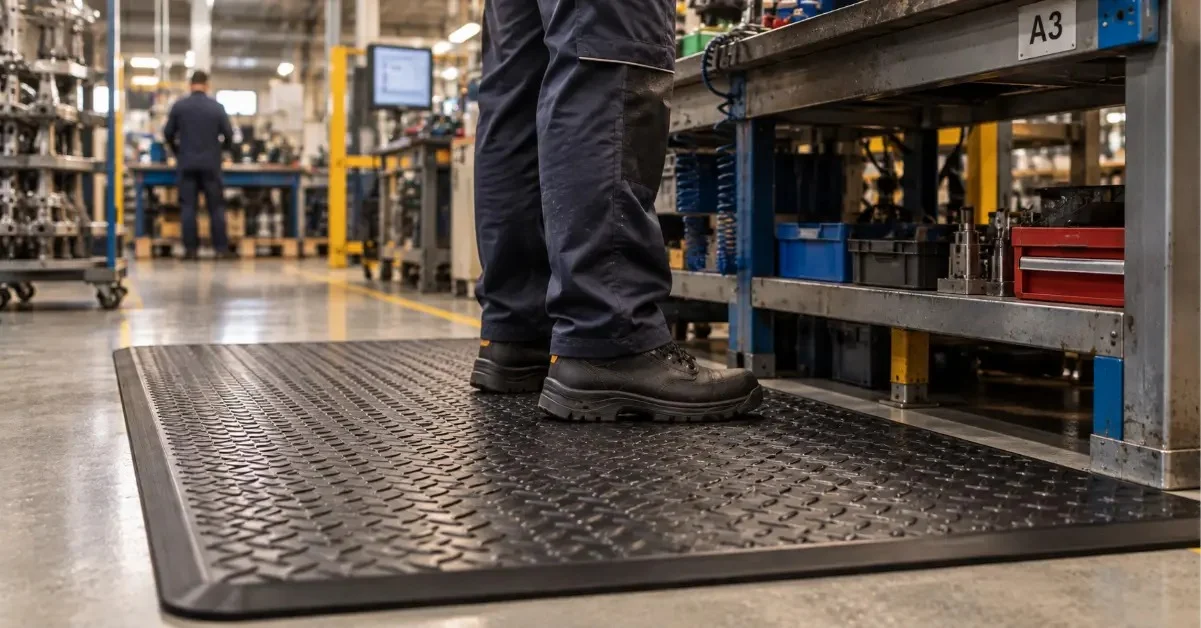
Standing for long periods can put continuous pressure on the feet and lower limbs, particularly when workers remain at the same workstation for much of the day.
The right mat can provide cushioning underfoot and make a standing workstation more comfortable. But choosing anti-fatigue mats for standing workstations is not simply about finding the thickest or softest mat available.
The working environment, duration of standing, floor surface, traffic, and type of work all need to be considered.
What Are Anti-Fatigue Mats?
Anti-fatigue mats are designed to provide a resilient surface for people who spend extended periods standing.
Unlike a hard floor, an appropriately designed mat provides some cushioning and allows subtle changes in posture and movement while standing.
This can make a workstation more comfortable, particularly where employees spend much of their working time on their feet.
However, mats should be considered as one part of a broader ergonomic approach. They do not eliminate the effects of prolonged standing on their own.
Why Use Anti-Fatigue Mats for Standing Workers?
People working at fixed stations may stand in one position for extended periods. Examples include production lines, packing stations, retail counters, service areas, and workshop benches.
Suitable anti-fatigue mats for standing workers can provide:
- A more cushioned standing surface
- Improved underfoot comfort
- A more resilient surface than hard flooring
- Additional grip in suitable workplace environments
- A defined standing area around a workstation
The actual benefit depends on the design of the mat and the conditions in which it is used.
Choosing Standing Workstation Mats
When selecting standing workstation mats, start with the task rather than the product.
Ask how long workers stand at the station, whether they move frequently, whether carts or equipment pass over the mat, and whether the environment is dry, wet, oily, or exposed to debris.
A mat suitable for a dry office workstation may not be appropriate for a busy industrial production area.
For additional guidance on selecting suitable floor matting for different applications, see these tips for choosing the right floor matting.
Key Features to Consider
Cushioning and Comfort
The primary purpose of an anti-fatigue mat is to provide a more comfortable standing surface.
However, excessive softness is not necessarily beneficial. A mat should provide appropriate cushioning while remaining stable enough for the work being performed.
For employees who spend several hours standing, ergonomic anti-fatigue mats can form part of a more comfortable workstation setup.
Surface Grip
The surface should provide suitable traction for the working environment.
In areas where workers may encounter water, dust, oils, or other contaminants, the mat’s surface pattern and drainage characteristics become particularly important.
The appropriate specification depends on the workplace conditions.
For workplaces where slip risks are a consideration, businesses can also review how the right rubber matting can help address slips and falls.
Mat Stability
A standing mat should remain securely positioned during normal use.
Curling edges, movement, or poorly fitted mats can create unnecessary trip hazards.
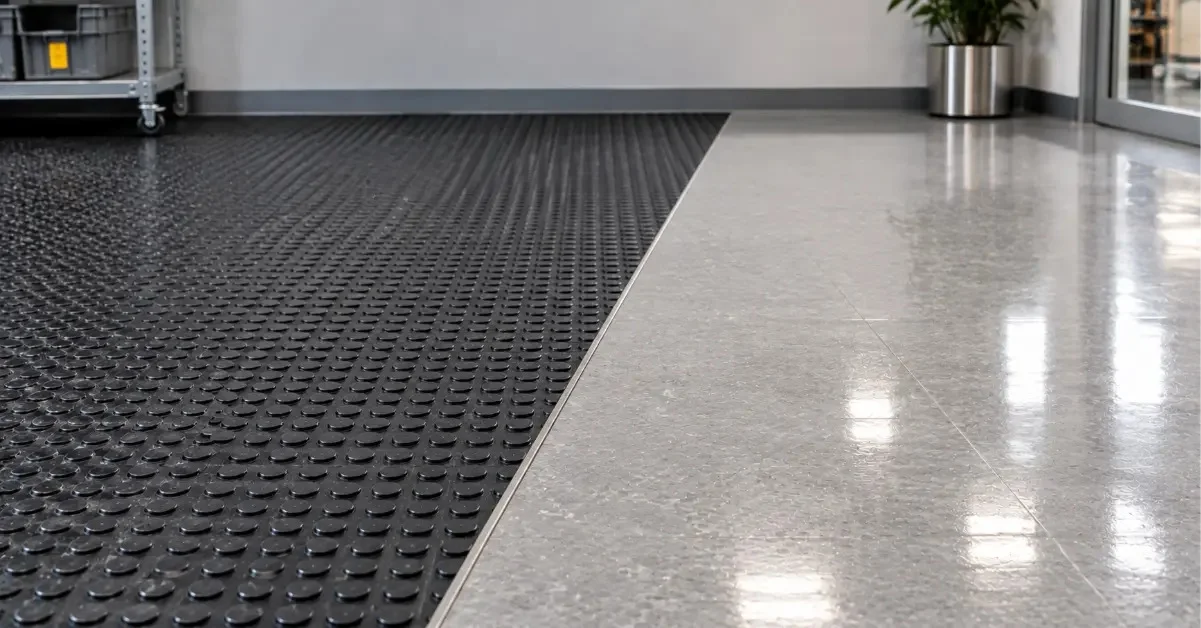
The mat should therefore be appropriately sized for the workstation and positioned on a suitable floor surface.
Durability
Industrial environments can subject mats to repeated foot traffic, equipment movement, impacts, and cleaning.
For these applications, look for products specifically designed for workplace or industrial use rather than choosing a general-purpose household mat.
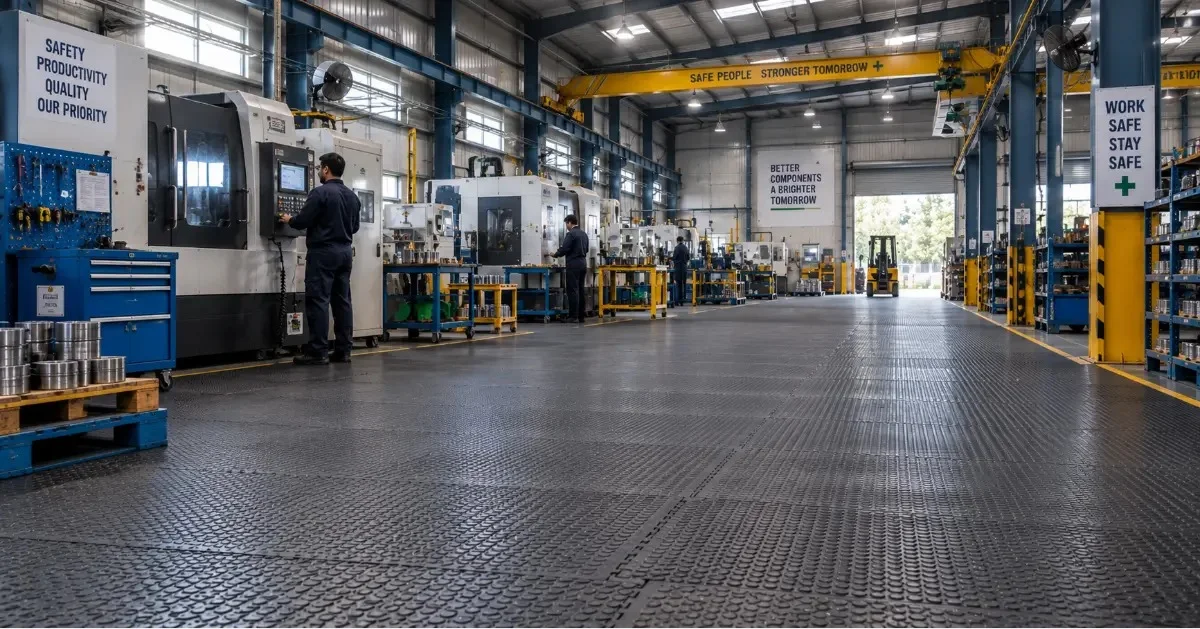
Anti-Fatigue Mats for Industrial Workstations
Industrial workstation mats need to do more than provide cushioning.
Production and manufacturing environments can involve oils, water, metal particles, tools, machinery, and frequent movement. The mat therefore needs to suit the conditions around the workstation.
Depending on the application, useful features may include:
- Slip-resistant surfaces
- Drainage or perforation
- Resistant rubber construction
- Bevelled edges
- Interlocking sections
- Easy-to-clean surfaces
The exact combination will depend on the workstation.
Anti-Fatigue Rubber Mats
Rubber is tough and can take a lot of use, so you’ll often see anti-fatigue rubber mats in industrial, commercial, and work settings.
Different rubber mats have different constructions. Some are designed specifically for standing workstations, while others focus on drainage, grip, or heavy-duty workplace use.
When choosing a rubber mat, check the manufacturer’s intended application and performance specifications rather than assuming that all rubber mats provide the same level of anti-fatigue support.
Businesses comparing different industrial flooring options can also review rubber mats vs PVC mats for industrial use.
Mats for Prolonged Standing
For mats for prolonged standing, consider the complete workstation rather than the mat in isolation.
The height of the work surface, worker posture, ability to change position, footwear, and opportunities to sit or move can all influence comfort.
A good workstation setup may therefore combine:
- An appropriate anti-fatigue mat
- Correct work-surface height
- Opportunities to change posture
- Suitable footwear
- Regular movement or task variation
This is particularly relevant where workers spend most of their shift standing in one location.
What Type of Mat Is Suitable for Different Workplaces?
Different workplaces can have very different requirements.
Manufacturing Workstations: Prioritise durability, grip, stability, and resistance to the substances encountered during the work.
Packing and Assembly Stations: Comfort and resilience can be important where employees stand for extended periods while repeatedly performing the same tasks.
Retail Counters: A well-sized anti-fatigue mat can provide additional cushioning where employees spend long periods standing behind a counter.
Workshops: Consider the possibility of tools, oils, water, and debris reaching the floor. A surface designed for the actual working conditions may be more appropriate than a standard standing mat. For commercial environments where flooring may need to handle moisture, food-related spills, frequent cleaning, and prolonged standing, see rubber matting for commercial kitchens.
Warehouses: Workers may need to move frequently, and equipment may pass through the area. Mat placement and edge design become particularly important.
How Thick Should an Anti-Fatigue Mat Be?
Thickness is one factor, but it should not be used as the only measure of performance.
A thicker mat is not necessarily more comfortable or more appropriate. The material, the density, the surface construction, the resilience, and the type of work being done all affect the feel and performance of a mat.
For industrial applications, choose according to the manufacturer’s specifications and intended use rather than selecting a thickness based on a general rule.
For a more detailed discussion of thickness considerations, see How Thick Should Industrial Rubber Mats Be?
How to Maintain Workplace Standing Mats
Regular cleaning helps maintain both hygiene and performance.
The right cleaning method will depend on the material of the mat and the conditions in the workplace. If your mats are exposed to oils, dust, or other contaminants, you may need to clean them more often than mats in a clean, indoor environment.
Also inspect mats regularly for:
- Damaged edges
- Cracks or surface deterioration
- Excessive wear
- Movement during use
- Accumulated debris
- Changes that could create a trip hazard
A damaged or heavily worn mat should be replaced when it can no longer perform safely.
For additional information on workplace slips, trips, floor conditions, and suitable control measures, refer to the Health and Safety Executive guidance on preventing slips and trips at work.
Choosing the Best Anti-Fatigue Mat
Before buying workplace standing mats, think about:
- How long do the workers stand? The longer you are standing, the more important cushioning and workstation ergonomics are.
- Is the workstation dry or exposed to liquids? Wet or contaminated environments may require a different surface design.
- Will equipment pass over the mat? Choose a mat designed to withstand the relevant traffic and load.
- Does the worker need to move frequently? Avoid creating an obstruction around a workstation where movement is essential.
- How will the mat be cleaned? Select a material and construction compatible with the workplace cleaning routine.
- Will the mat stay securely in place? Check the edges, dimensions, and floor compatibility before installation.
Choosing Anti-Fatigue Mats from ARAMATS
ARAMATS offers rubber matting designed for industrial and workplace applications, including anti-fatigue solutions for standing workstations.
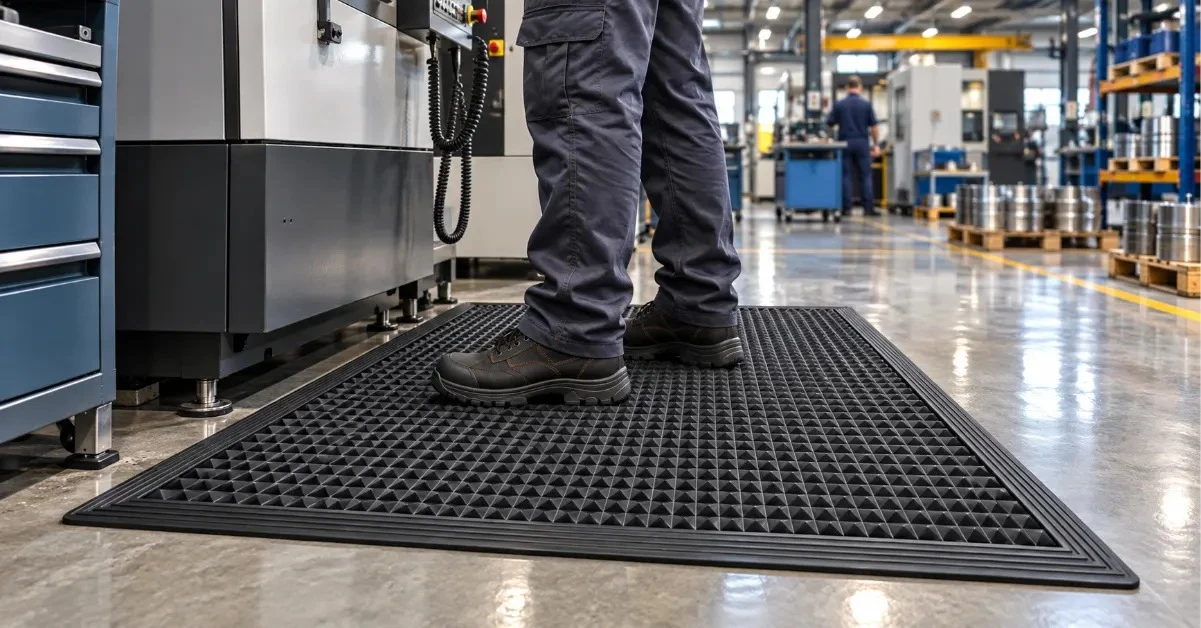
Its industrial range includes options such as Finger-Tip Anti-Fatigue Mats, Pyramid Pin Mats, and Comfort Lock Mats, with different constructions designed for different workplace requirements.
The right choice depends on the workstation, surrounding conditions, and type of activity rather than simply selecting the thickest available product.
Conclusion
Choosing anti-fatigue mats for standing workstations starts with understanding how the workstation is used.
For people who spend long periods on their feet, the right mat can provide a more resilient and comfortable surface. But the mat should also be stable, durable, and appropriate for the surrounding conditions.
Find the Right Anti-Fatigue Mat
ARAMATS offers anti-fatigue and industrial rubber matting solutions for different workplace environments and workstation requirements.
Explore the ARAMATS anti-fatigue and industrial rubber matting range to find a mat suited to your standing workstation and working conditions.
Frequently Asked Questions
What are anti-fatigue mats for standing workers?
Anti-fatigue mats for standing workers are resilient floor mats that are designed to provide cushioning and increase comfort for people who stand for long periods at a workstation.
Are anti-fatigue mats useful for prolonged standing?
They can make standing surfaces more comfortable, but they should be used alongside good workstation design, opportunities for movement, and appropriate working practices.
What are the best anti-fatigue mats for industrial workstations?
The appropriate industrial workstation mats depend on the environment. Consider traffic, standing time, liquids, oils, debris, equipment movement, grip, and cleaning requirements before selecting a product.
Are rubber mats good for standing workstations?
Anti-fatigue rubber mats can be suitable for standing workstations because rubber can provide a resilient and durable surface. However, different rubber mats are designed for different applications.
How thick should an anti-fatigue mat be?
There is no universal thickness requirement. Ergonomic anti-fatigue mats should be selected based on their construction, resilience, intended use, and the conditions of the workstation rather than thickness alone.
What should I look for in workplace standing mats?
Look at cushioning, stability, grip, durability, edge design, cleaning requirements, and compatibility with the workplace environment.

Written by the ARAMATS team at Arackathara Group, manufacturers and exporters of rubber matting solutions since 1973.