
ARAMATS Team
Written by the ARAMATS team at Arackathara Group, manufacturers and exporters of rubber matting solutions since 1973.
Written by the ARAMATS team at Arackathara Group, manufacturers and exporters of rubber matting solutions since 1973.
Commercial kitchens are busy, demanding spaces where water, grease, food debris and constant foot traffic are part of everyday work.
For staff working for long hours on hard floors, the right mat can provide more than basic floor coverage. It can support underfoot grip, improve standing comfort and, in suitable designs, help manage water around wet work areas. Businesses looking at standing comfort can also explore anti-fatigue mats for industrial workstations.
But choosing rubber mats for commercial kitchens UK businesses actually need is not simply about picking the thickest or most heavily marketed product. Different areas of a kitchen have different requirements.
Kitchen floors can become wet or contaminated around sinks, dishwashing stations, cooking areas, and food preparation zones.
Suitable rubber matting can provide an additional working surface with features such as grip, drainage, and cushioning, depending on the design.
ARAMATS’ current commercial kitchen guidance highlights drainage, surface design, durability, cleaning and comfort as important considerations when selecting kitchen matting.
Matting should, however, be part of a wider approach to workplace safety. It does not replace appropriate flooring, cleaning routines or prompt spill management.
When comparing commercial kitchen rubber mats UK options, start with the conditions in which the mat will actually be used.
Water, oil, and grease can make kitchen floors challenging underfoot. A textured rubber surface can provide additional traction, but not every mat performs in the same way under every condition.
When choosing anti-slip kitchen mats UK businesses can use, consider the type of contamination, the floor underneath, and the work being carried out in that area.
The mat should also remain stable and flat during normal use.
For additional information about reducing workplace slip and trip risks with appropriate matting, see how the right rubber matting can help address slips and falls.
Water is particularly common around sinks, washing areas, and other wet workstations.
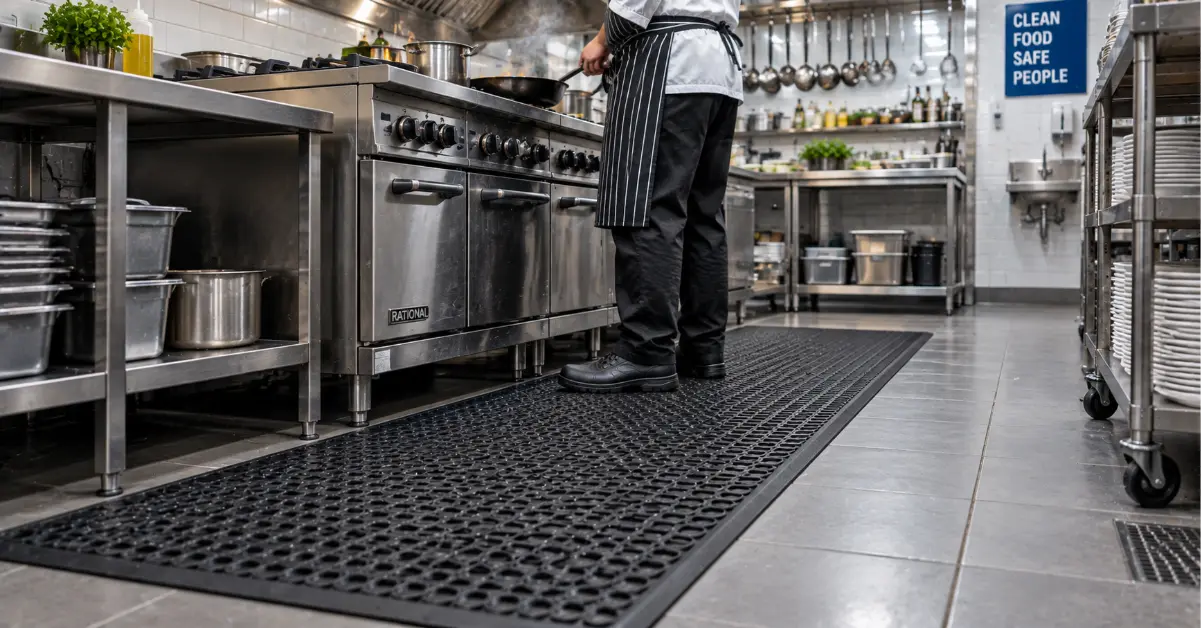
Drainage mats for commercial kitchens are designed with openings or raised structures that allow liquids to move away from the main standing surface.
They can be useful around:
However, drainage mats still require regular cleaning. Food particles and debris can collect within or beneath the mat if maintenance is neglected.
Kitchen employees can spend much of their working day standing at a particular station.
A cushioned mat can provide a more comfortable surface underfoot, especially around preparation counters, cooking stations, and other fixed work areas.
For longer periods of standing, anti-fatigue matting may be worth considering. Aramats offers several restaurant kitchen mat designs specifically aimed at anti-fatigue applications.
Commercial kitchens operate continuously in many settings, so their floor mats need to cope with repeated foot traffic, moisture, cleaning, and everyday wear.
This is where choosing suitable industrial kitchen mats can become relevant for larger or particularly demanding food-service environments.
Durability should be assessed according to the actual workload rather than simply choosing a thicker product.
Not every area of a commercial kitchen needs the same mat.
These are naturally wet areas. A drainage design can be useful because water can pass through the openings instead of remaining on the main standing surface.
Regular cleaning underneath the mat remains important.
Preparation staff may spend long periods standing in one location.
Here, a cushioned or anti-fatigue mat can provide additional comfort, while a suitable textured surface can support underfoot stability.
Cooking areas can be exposed to grease, food spills, and constant movement.
The mat selected for these areas should be appropriate for the conditions and easy for staff to clean and maintain.
Storage routes and busy service areas can be very busy.
Instead of needlessly matting an entire floor, businesses can evaluate specific workstations and high-use areas to pinpoint where matting offers the most practical benefit.
Both can have a place in a commercial kitchen. Drainage mats are generally useful where water is regularly present. Their open construction allows liquids to move away from the primary standing surface.
Solid mats may be more appropriate for relatively dry workstations where cushioning, comfort, and a stable surface are the main priorities.
For commercial kitchen floor mats, the choice should therefore be based on the conditions of each area.
Consider this:
One kitchen may need several different matting solutions rather than one product throughout.
A mat is only one part of workplace safety.
For kitchen safety matting UK businesses are considering, placement is just as important as the mat itself.
The mat should lie flat on the floor without lifting at the edges and should be placed so as not to block walkways, doorways or equipment.
Regular checking is also important. Other hazards are created by damaged surfaces, curled edges, or mats that have moved out of position.
Cleaning underneath the mat is equally important, particularly in wet or food-preparation areas.
The UK Health and Safety Executive provides guidance on preventing slips and trips at work, including controlling contamination, maintaining floors and keeping work areas safe. See the HSE guidance on preventing slips and trips at work.
Non-slip rubber mats for kitchens can provide additional underfoot grip in appropriate areas, but businesses should look beyond the “non-slip” label.
The actual working environment matters. Water, grease, floor contamination, footwear, and the condition of the underlying floor can all affect how safe a working surface is.
This is why the mat should be selected according to the specific kitchen application rather than relying on a general product description.
Businesses can also compare rubber mats vs PVC mats for industrial use when assessing which material is better suited to particular industrial and commercial applications.
Before you buy, find out where matting is actually needed.
If there is water regularly, think drainage.
Staff who have to stand for long periods of time may find the cushioning and anti-fatigue properties useful.
Think about whether it’s mainly exposed to water, food particles, grease, oil, or a combination of all of them.
Commercial kitchens are high-traffic areas and need matting that can take daily use.
The mat should fit in with the cleaning routine already established in the kitchen. Staff should be able to lift, clean, inspect, and move it if needed.
The mat should cover the intended work area without creating an obstruction or trip point around it.
For more general guidance when evaluating different floor-matting requirements, see tips for choosing the right floor matting.
Aramats offers a range of restaurant kitchen mats, including anti-fatigue and drainage designs. Its current kitchen range includes Anti-Fatigue Restaurant Mats, Anti-Fatigue Work-Safe Mats, Anti-Fatigue Ramp Mats, Anti-Fatigue Box Ramp Mats, and drainage mat options.
The choice between these designs depends on whether the priority is standing comfort, drainage, workstation coverage, or a combination of requirements.
For commercial kitchens, this application-based approach is more useful than treating every part of the floor in the same way.
But even a durable mat needs maintenance.
A simple routine might include:
Drainage mats deserve particular attention because food particles and other debris can collect within the openings.
The choice of the right kitchen mat is a matter of matching the product to the working environment.
Wet areas may require drainage. Fixed work stations may have the advantage of cushioning. Areas of service and cooking that are busy will require durable matting to withstand frequent use and cleaning.
Instead of looking for one “best” mat for every situation, assess each area of the kitchen and choose according to its specific requirements.
For businesses comparing rubber mats for commercial kitchens UK options, factors such as drainage, grip, comfort, durability, cleaning, and placement can make the difference between a mat that covers the floor and one that genuinely supports the working environment.
Need help finding suitable rubber matting for a commercial kitchen, restaurant, or food-service environment?
Explore ARAMATS’ commercial kitchen matting range and choose a solution based on your kitchen’s specific working conditions.
The right mat depends on the application. Wet areas may require drainage, while fixed standing workstations may benefit from anti-fatigue cushioning. Traffic, contamination and cleaning requirements should also be considered.
Some are specifically designed for wet environments. Drainage mats can allow water to pass through their openings, making them suitable for selected wet work areas.
They are designed to allow liquids to move away from the primary standing surface. They can be useful around sinks, dishwashing stations and other areas where water is regularly present.
Matting can provide additional underfoot grip, but it should form part of a wider safety approach that includes suitable flooring, cleaning, spill management and appropriate workplace practices.
Depending on the design, they can provide additional traction and create a more stable working surface. The actual suitability depends on the floor, contamination, and conditions where the mat is used.
Anti-fatigue rubber mats can provide additional cushioning at fixed workstations where employees spend extended periods standing. The appropriate design depends on the workstation and working conditions.
How often you need to clean depends on the kitchen, amount of contamination, and design of the mat. Food debris and spills need to be cleaned up quickly, and mats and the floor underneath need to be cleaned regularly, according to the manufacturer’s instructions.
They can be suitable for demanding commercial food-service environments where matting needs to withstand frequent use, moisture, cleaning, and prolonged standing. The specific product should be selected according to the working conditions.